The heart in the skin
How ultraviolet radiation releases the skin's nitric oxide to regulate blood pressure and fight cardiovascular risk

We live in an age of biological contradictions. We spend most of the day under concrete roofs, lit by screens and wrapped in a widespread fear of our nearest star. We have been taught to see the sun only through the lens of premature ageing and melanoma, and to retreat into the shade or cover ourselves in chemical filters at the slightest glimmer. Meanwhile, cardiovascular disease is still the leading cause of death worldwide, and the risk factor that weighs most heavily on it is one the sun has a lot to say about: high blood pressure.
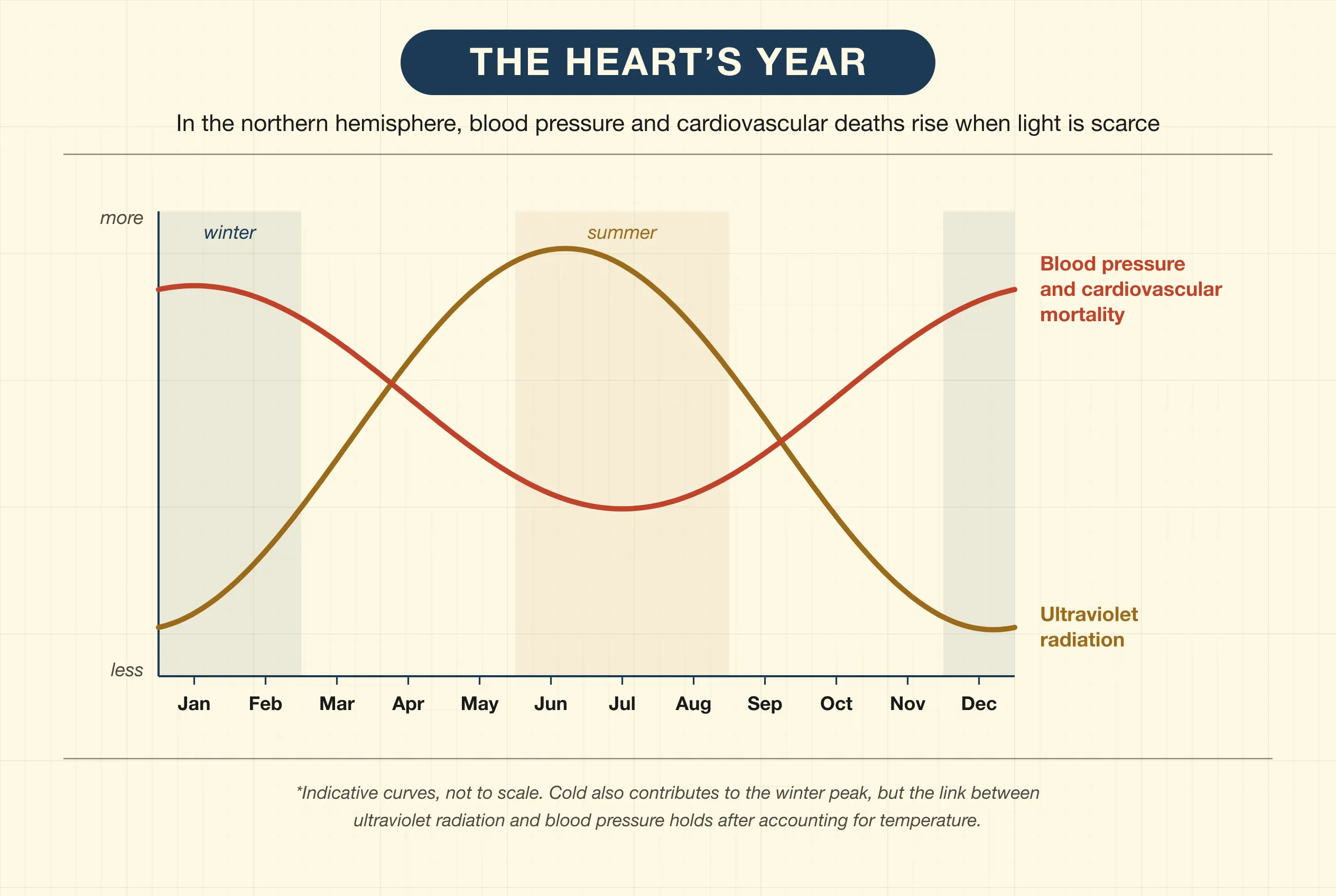
What if, by hiding from the sun, we were depriving our arteries of one of their oldest regulators? The skin is not just a barrier: it also works as an endocrine and metabolic organ that, when it receives sunlight, sets off a chemical cascade capable of relaxing the arteries and lowering blood pressure.
A gas that relaxes the arteries
Almost everyone associates the benefits of the sun with vitamin D and bone health. But the cardiovascular system responds to a different mechanism, independent of that vitamin, whose protagonist is a tiny molecule: nitric oxide (NO).
This gas is a powerful vasodilator, and its role as a messenger of the cardiovascular system earned the 1998 Nobel Prize in Medicine. It is the signal that tells the muscle wrapped around the arteries to relax: as it does, the artery widens, blood flows with less resistance and blood pressure falls. And very little is needed: by the plain physics of fluids, widening a vessel by just 10% cuts the resistance the blood meets by almost a third.
The cellular factory: the L-arginine pathway
Our body makes this gas non-stop. It is produced by the endothelium, the thin layer of cells lining the inside of blood vessels, thanks to an enzyme, eNOS, which makes it from an amino acid in our diet: L-arginine. From there, the gas travels just a few micrometres to the muscle of the artery and lowers the calcium in its cells; with less calcium, the muscle relaxes and the vessel opens.
When this pathway fails, mainly because of oxidative stress, which destroys the gas as soon as it forms, the arteries lose flexibility. This is known as endothelial dysfunction, an early change that accompanies hypertension and atherosclerosis.
The skin, a nitric oxide battery
Where does the sun fit into all this? Nitric oxide lasts only a few seconds, but it doesn’t vanish without a trace: it turns into more stable compounds—nitrate, nitrite and nitrosothiols—that travel in the blood and that the skin stores in considerable amounts, much of them in its outermost layer, right where the sun reaches. The skin thus works as a chemical battery from which the gas can be recovered.
The skin is not just a protective layer, but a store of nitric oxide that opens when sunlight touches it.
How UVA light releases the gas
When ultraviolet A radiation (UVA), the part of the ultraviolet that penetrates deepest into the skin, reaches these stores, its energy breaks the compounds apart and releases active nitric oxide. This is called photolysis, a splitting caused by light: no enzyme is involved; sunlight is enough. Part of the gas dilates the vessels of the skin itself; the rest passes into the circulation, disguised once more as nitrite and nitrosothiols, and blood pressure falls.
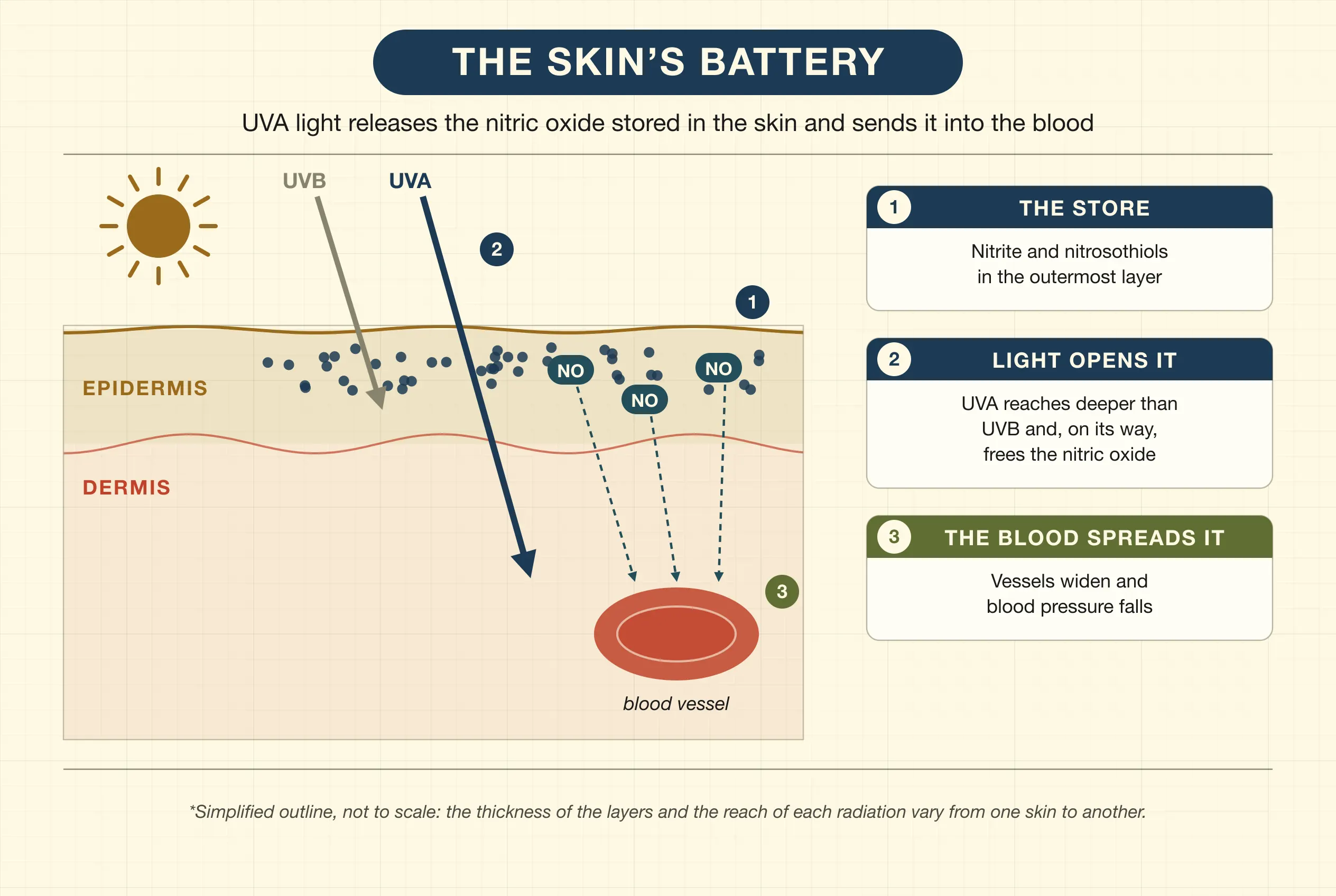
Trials in volunteers confirm it: a single session of UVA lowers blood pressure, and the effect lasts up to an hour. Neither the heat of the lamps nor vitamin D explains it; UVA doesn’t even make vitamin D, which is UVB’s job. And light keeps dilating the vessels even when the endothelial enzyme is blocked: the gas is not coming from the factory, but from the store.
Support from the diet
It is worth clearing up something many supplement labels muddle: nitric oxide is not something you eat. No food contains it, because it is a fleeting gas that the body makes and uses on the spot. What the diet does provide is the raw material for a second route that doesn’t depend on eNOS: the nitrate-nitrite-nitric oxide pathway.
Vegetables such as beetroot, rocket, spinach and celery accumulate nitrate from the soil, and its journey through the body is a curious one. Once absorbed in the gut, nitrate passes into the blood and from there returns to the mouth: the salivary glands collect it and send it back out in the saliva. Bacteria living on the tongue turn it into nitrite; when we swallow our saliva, that nitrite returns to the blood, and the tissues, especially those running short of oxygen, finally convert it into nitric oxide.
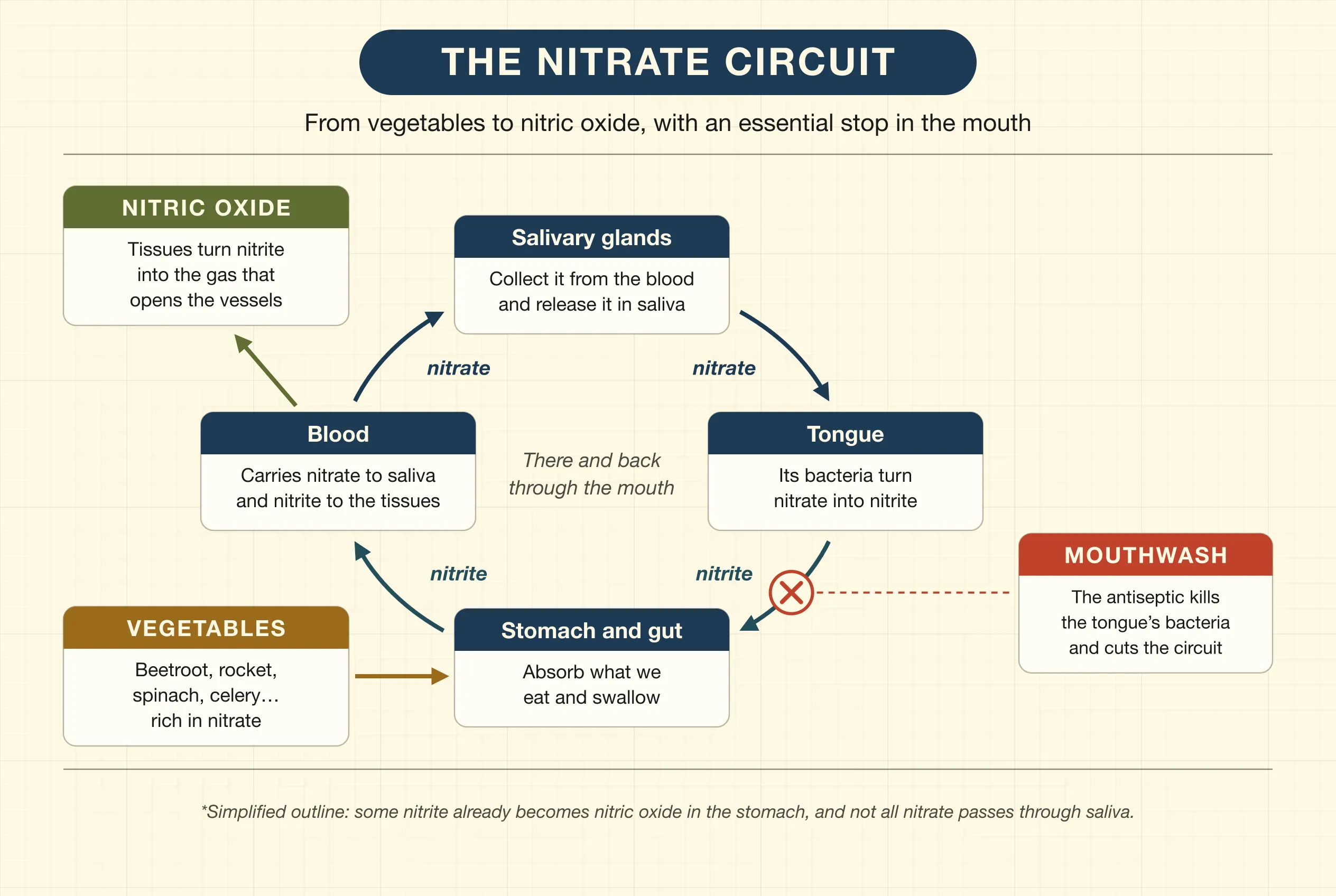
It is a circuit with real effects—a daily glass of beetroot juice lowers blood pressure in people with hypertension—and the mouth is an essential part of it: if the saliva is spat out instead of swallowed, the effect disappears. That gives it an unexpected weak spot: antiseptic mouthwash. By wiping out the bacteria on the tongue, it cuts the circuit, and daily use is enough to nudge blood pressure up within a few days. The point is not to give up mouthwash altogether, but to choose one without strong antiseptics such as chlorhexidine and not to turn it into a daily habit without need.
Does that nitrate top up the skin’s battery? It may, but this has not been proven. For now, the prudent view is to see them as two routes that add up: light opens the skin’s store, and vegetables and saliva keep up the blood’s nitrite.
An adapted heart that beats to the rhythm of its environment
Human beings did not evolve cut off from their environment. The heart and circulatory system are not isolated machines that respond only to drugs: they are open systems that are also regulated by food, air and sunlight.
A session in the sun doesn’t change anyone’s blood pressure for ever; what weighs on the heart is everyday blood pressure. And there, light seems to count too: besides the winter rise shown by the curves at the start, wherever more ultraviolet radiation reaches, blood pressure tends to be lower, and not just because of the heat.
Of course, benefiting from this mechanism requires mindful, self-directed and adapted sun exposure. The skin is a dynamic organ that develops tolerance—what is sometimes called a sun callus. Someone used to life outdoors will have trained skin, with a melanin density and optimised antioxidant systems capable of mobilising large amounts of nitric oxide safely. By contrast, someone who spends the day under artificial light should seek more gradual stimuli to avoid the erythema and oxidative stress of sunburn.
Understanding that the sun is an indispensable environmental nutrient, and that our skin is in charge of turning that light into arterial health, is the first step towards losing an unjustified fear and starting to live facing the light, protecting our heart from the surface of our skin.
References and scientific support
- Cardiovascular disease caused 19.2 million deaths in 2023, and high blood pressure tops its modifiable risk factors. Global Burden of Cardiovascular Diseases and Risks 2023 Collaborators. (2025). Global, regional, and national burden of cardiovascular diseases and risk factors in 204 countries and territories, 1990-2023. Journal of the American College of Cardiology, 86(22), 2167-2243. View study (DOI)
- Furchgott’s Nobel lecture: how the factor that relaxes arteries turned out to be nitric oxide. Furchgott, R. F. (1999). Endothelium-derived relaxing factor: discovery, early studies, and identification as nitric oxide. Bioscience Reports, 19(4), 235-251. View the lecture (DOI)
- The skin holds stores of nitrate and nitrite that UVA mobilises without the need for enzymes. Mowbray, M., McLintock, S., Weerakoon, R., Lomatschinsky, N., Jones, S., Rossi, A. G., & Weller, R. B. (2009). Enzyme-independent NO stores in human skin: quantification and influence of UV radiation. Journal of Investigative Dermatology, 129(4), 834-842. View study (DOI)
- With a labelled nitrite cream, the skin’s nitric oxide shows up in the blood after UVA, and blood pressure falls by around 11% for an hour. Opländer, C., Volkmar, C. M., Paunel-Görgülü, A., van Faassen, E. E., Heiss, C., Kelm, M., Halmer, D., Mürtz, M., Pallua, N., & Suschek, C. V. (2009). Whole body UVA irradiation lowers systemic blood pressure by release of nitric oxide from intracutaneous photolabile nitric oxide derivates. Circulation Research, 105(10), 1031-1040. View study (DOI)
- Compared with a session with the same heat but no radiation, 22 minutes of UVA lower diastolic pressure by about 5 mmHg, without relying on eNOS or vitamin D. Liu, D., Fernandez, B. O., Hamilton, A., Lang, N. N., Gallagher, J. M. C., Newby, D. E., Feelisch, M., & Weller, R. B. (2014). UVA irradiation of human skin vasodilates arterial vasculature and lowers blood pressure independently of nitric oxide synthase. Journal of Investigative Dermatology, 134(7), 1839-1846. View study (DOI)
- The reference review on the nitrate-nitrite-nitric oxide pathway, an alternative to the L-arginine route. Lundberg, J. O., Weitzberg, E., & Gladwin, M. T. (2008). The nitrate-nitrite-nitric oxide pathway in physiology and therapeutics. Nature Reviews Drug Discovery, 7(2), 156-167. View paper (DOI)
- A daily glass of beetroot juice lowers systolic pressure by about 8 mmHg in people with hypertension within four weeks and improves their endothelial function. Kapil, V., Khambata, R. S., Robertson, A., Caulfield, M. J., & Ahluwalia, A. (2015). Dietary nitrate provides sustained blood pressure lowering in hypertensive patients: a randomized, phase 2, double-blind, placebo-controlled study. Hypertension, 65(2), 320-327. View study on PubMed Central
- Half a litre of beetroot juice lowers blood pressure by up to 10/8 mmHg within three hours, but not if the saliva is spat out. Webb, A. J., Patel, N., Loukogeorgakis, S., Okorie, M., Aboud, Z., Misra, S., Rashid, R., Miall, P., Deanfield, J., Benjamin, N., MacAllister, R., Hobbs, A. J., & Ahluwalia, A. (2008). Acute blood pressure lowering, vasoprotective, and antiplatelet properties of dietary nitrate via bioconversion to nitrite. Hypertension, 51(3), 784-790. View study on PubMed Central
- A week of chlorhexidine cuts the mouth’s nitrite production by 90% and raises blood pressure in healthy people by 2 to 3.5 mmHg. Kapil, V., Haydar, S. M. A., Pearl, V., Lundberg, J. O., Weitzberg, E., & Ahluwalia, A. (2013). Physiological role for nitrate-reducing oral bacteria in blood pressure control. Free Radical Biology and Medicine, 55, 93-100. View study on PubMed Central
- Three days of antiseptic mouthwash are enough to raise systolic pressure by 2.3 mmHg in treated hypertensive patients. Bondonno, C. P., Liu, A. H., Croft, K. D., Considine, M. J., Puddey, I. B., Woodman, R. J., & Hodgson, J. M. (2015). Antibacterial mouthwash blunts oral nitrate reduction and increases blood pressure in treated hypertensive men and women. American Journal of Hypertension, 28(5), 572-575. View study (DOI)
- In one million adults, each 20 mmHg of higher usual systolic pressure doubles stroke and coronary mortality in middle age, with no threshold down to at least 115/75. Lewington, S., Clarke, R., Qizilbash, N., Peto, R., Collins, R., & Prospective Studies Collaboration. (2002). Age-specific relevance of usual blood pressure to vascular mortality: a meta-analysis of individual data for one million adults in 61 prospective studies. The Lancet, 360(9349), 1903-1913. View study (DOI)
- In 342,457 dialysis patients, blood pressure rises in winter and is lower where more ultraviolet radiation reaches, even after accounting for temperature. Weller, R. B., Wang, Y., He, J., Maddux, F. W., Usvyat, L., Zhang, H., Feelisch, M., & Kotanko, P. (2020). Does incident solar ultraviolet radiation lower blood pressure? Journal of the American Heart Association, 9(5), e013837. View study on PubMed Central
- Among 29,518 women followed for twenty years, those who avoided the sun had twice the mortality of the most exposed. Lindqvist, P. G., Epstein, E., Landin-Olsson, M., Ingvar, C., Nielsen, K., Stenbeck, M., & Olsson, H. (2014). Avoidance of sun exposure is a risk factor for all-cause mortality: results from the Melanoma in Southern Sweden cohort. Journal of Internal Medicine, 276(1), 77-86. View study (DOI)
- Avoiding the sun, a risk of similar magnitude to smoking, largely through cardiovascular mortality. Lindqvist, P. G., Epstein, E., Nielsen, K., Landin-Olsson, M., Ingvar, C., & Olsson, H. (2016). Avoidance of sun exposure as a risk factor for major causes of death: a competing risk analysis of the Melanoma in Southern Sweden cohort. Journal of Internal Medicine, 280(4), 375-387. View study (DOI)
- Twenty-one trials and 83,291 participants: vitamin D pills do not reduce cardiovascular events. Barbarawi, M., Kheiri, B., Zayed, Y., Barbarawi, O., Dhillon, H., Swaid, B., Yelangi, A., Sundus, S., Bachuwa, G., Alkotob, M. L., & Manson, J. E. (2019). Vitamin D supplementation and cardiovascular disease risks in more than 83 000 individuals in 21 randomized clinical trials: a meta-analysis. JAMA Cardiology, 4(8), 765-776. View study (DOI)
We're building the space for you to comment on the articles.
Continue reading

Sunlight against H. pylori
How UVB radiation and vitamin D3 switch on the natural defenses that fight this gastric pathogen

Endless cold or “broken” gut?
How your microbiota dictates your defenses, your headaches and your daily energy

The invisible link between the sun and the gut microbiota
How UVB radiation switches on receptors that reinforce the intestinal barrier and tune immunity