The Zeigarnik effect, or the cost of having brilliant ideas
The psychological phenomenon that sabotages your rest in the name of creativity

You switch off the light, settle into the pillow and close your eyes, ready to rest. Yet that work problem that has been plaguing you all afternoon refuses to leave. Hours later, in the middle of a strange, hazy dream, the miracle happens: the pieces fall into place and you see the solution with astonishing clarity. You wake up, examine it and, sure enough, it works. It feels like magic, a gift from the night-time muses. The problem is that you get up as exhausted as if you had spent the whole night breaking rocks.
Why does our brain refuse to hang up the “closed for rest” sign when we face an intellectual or creative challenge? Why pay such a high toll for a good idea? The answer lies at a crossroads between last century’s psychology and cutting-edge neuroscience.
The mind hates unfinished stories
To understand why your brain takes work to bed, we have to travel to 1920s Berlin. The Soviet psychologist Bluma Zeigarnik was sitting in a café with her colleagues when she noticed something peculiar about the waiters: they could remember complex, detailed orders perfectly for tables that had not yet paid. Yet the moment the bill was settled and the service was over, those memories vanished from their minds almost instantly.
Zeigarnik went back to her laboratory and demonstrated a universal truth: the human brain generates an internal cognitive tension in the face of any unfinished task. A complex problem you leave half-solved at the end of your working day behaves exactly like the unpaid bill in that Berlin café. Your conscious mind may switch off when you leave the office or close your laptop, but your subconscious keeps that “open loop” running in the background, treating it as an urgent priority to be resolved as soon as possible. This is what modern psychology calls night-time work-related rumination.
Tetris effect or work-related rumination?
It is very common to confuse this phenomenon with the famous Tetris effect, but occupational neuropsychology demands that we draw a very clear line between the two.
The Tetris effect is a mechanism of mechanical and sensory transfer. It happens when you spend hours on a monotonous, repetitive or purely visual activity, such as playing the falling-blocks video game, sorting boxes in a warehouse or filling in identical rows in a spreadsheet. When you go to sleep, your brain simply keeps replaying the visual loop out of the sheer inertia of the sensory receptors. It is a leftover photocopy of the day: it requires no logical effort and is not trying to solve anything.
Work-related rumination, on the other hand, is high-level abstract processing. You are not replaying mechanical images; you are actively searching for solutions to complex, analytical or creative problems. Your brain is crossing variables, weighing risks and redesigning structures under an enormous cognitive load. It is not inertia: it is the intellectual engine running at full power in the middle of the night.
The Russian chemist Dmitri Mendeleev had spent days obsessed with arranging the known elements of the universe without finding a logical pattern. Exhausted, he fell asleep at his desk. In his own words: “I saw in a dream a table where all the elements fell into place as required. Awakening, I immediately wrote it down”.
The neuropsychology of the night-time “eureka moment”
The most curious thing is that, exhausting as it is, this process is a remarkably efficient creative machine. When night-time work-related rumination moves into REM sleep (the stage in which the most vivid dreams occur), our brain gains cognitive advantages it would never have while awake, thanks to two main phenomena.
Switching off the logical censor
While you are awake, your thinking is governed by the dorsolateral prefrontal cortex. This region is in charge of strict logic, social norms, critical judgement and self-control. It is the “filter” that tells you: “this idea is too expensive”, “this makes no sense” or “that’s impossible”.
During REM sleep, however, the activity of this area drops sharply. With that censor no longer watching over the work, your mind becomes extraordinarily free. It allows itself to try daring, absurd and hyper-creative conceptual combinations that you would have dismissed at once as ridiculous while awake.
The default mode network highway
When you are awake and stressed about solving a problem, you suffer from what psychologists call tunnel vision: you fixate on a single logical route. When you sleep, the default mode network takes over. This network connects brain areas that are geographically very far apart. With no directed attention, a random childhood memory or an abstract analogy can cross paths with the current work problem and become the missing piece of the puzzle.
Why does the brain prefer to solve problems at night?
Far from being a flaw in our biology, this night-time activity has a deep evolutionary reason linked to neuroplasticity. During the day, the brain is in reactive mode: it spends all its resources interacting with the environment, dodging traffic, responding to immediate stimuli and keeping us alive.
Night is the only time when the brain can devote itself to memory consolidation and adaptation. Cut off from the body’s senses, it takes the opportunity to reorganise the information it has received, break old neural connections and build new synapses. When a complex problem obsesses us, the brain reads that unknown as vital to our adaptive survival and gives that material priority in its night-time reconfiguration work. Solving the puzzle in your dreams is the side effect of a brain trying to learn and update itself so that, the next day, you are a more efficient individual.
Some professions are an absolute breeding ground for night-time rumination. People who work in software development, user experience (UX) design or architecture handle invisible logical worlds of high abstraction. With no tangible physical object to “put down” at the end of the working day, logical structures, flows and code variables keep floating in working memory with far greater persistence and cognitive inertia than in jobs based on manual tasks.
The paradox of rest: the high biological cost
Solving the riddle while you sleep feels like an absolute intellectual victory, but biologically you are paying with your own health. The mental and physical exhaustion you wake up with stems from three drastic changes in the biochemistry of your rest.
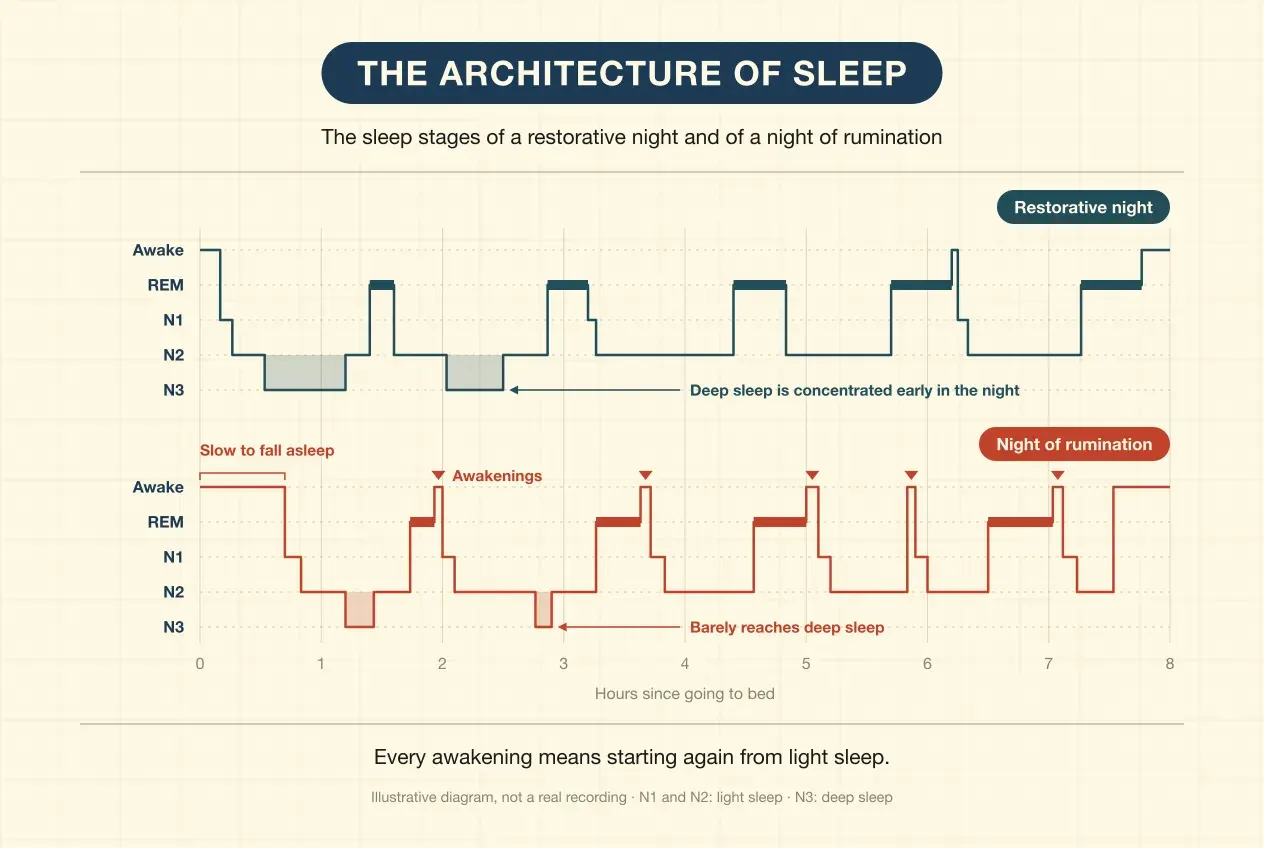
1. Intrusion of waking brain waves
In truly restorative sleep, brain waves should be slow and deep (delta waves). However, electroencephalographic studies show that when the brain processes analytical logic in dreams, fast brain waves (beta and gamma) appear abnormally — the very waves of daytime intellectual effort. Your body may be still, but your mind is experiencing the electrical activity of a working day.
2. A chemical storm of hyperarousal
For the brain to rest during REM sleep, noradrenaline (the hormone of stress and attention) must fall to zero, letting acetylcholine steer the flow of memory and plasticity in a relaxed way. But if the work problem comes with even the slightest worry or deadline pressure, cortisol levels shoot up during the night. This activates the sympathetic nervous system: your heart rate fluctuates and your body stays in a latent state of “fight or flight”.
3. The glymphatic system shuts down
This state of hyperarousal fragments the architecture of sleep. It causes imperceptible micro-awakenings and blocks sustained access to deep sleep (stage N3 of non-REM sleep, formerly divided into stages 3 and 4). Biologically, this is disastrous.
During deep sleep the glymphatic system switches on, working as the brain’s “dishwasher”. At this stage, the space between brain cells grows by around 60%. Cerebrospinal fluid then flows under pressure through the whole of the brain tissue, flushing away the metabolic waste and toxins accumulated during the day, such as the beta-amyloid protein.
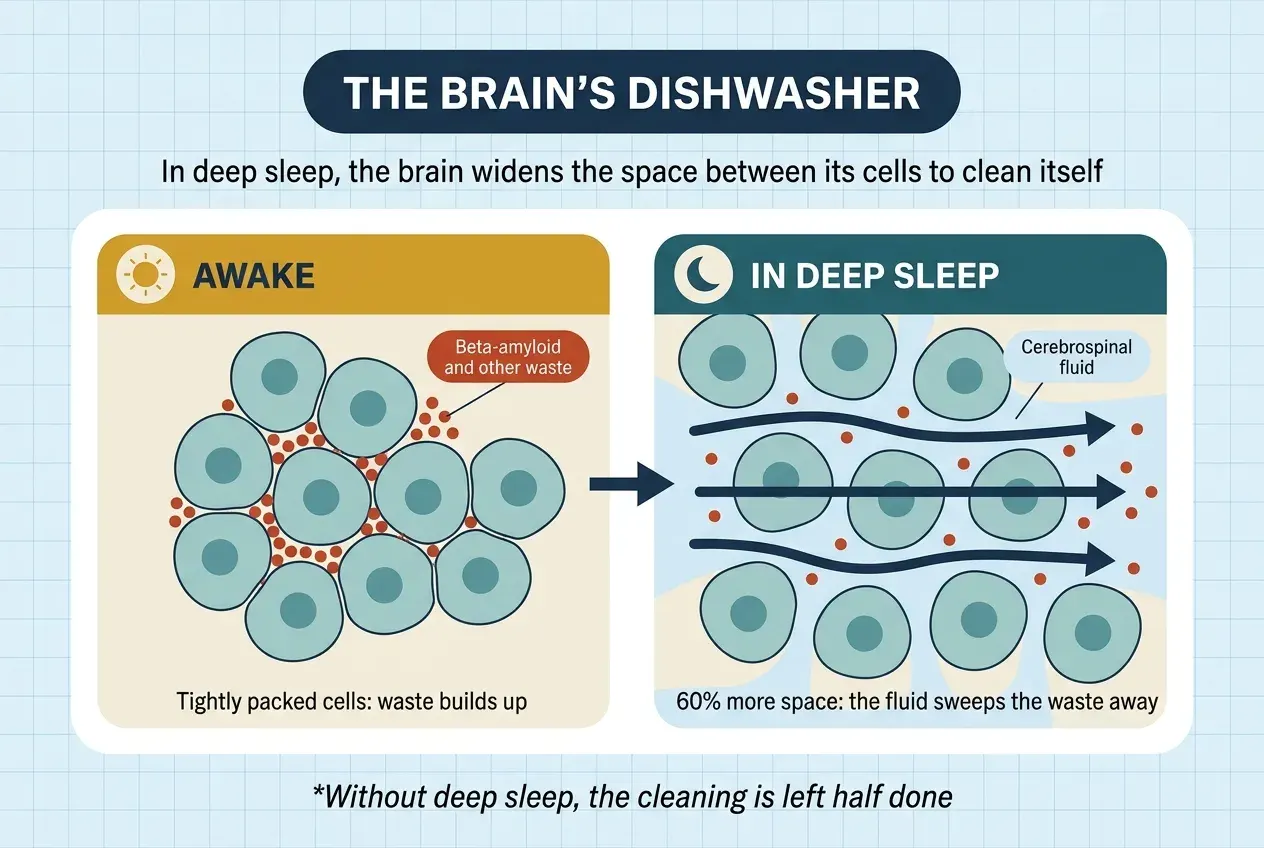
If your brain would rather stay in REM solving logical problems and skips deep sleep, the dishwasher never runs. You wake up with the solution to the problem in your hand, but with a “dirty” brain, saturated with chemical waste and deeply fatigued.
How to “pay the bill” before going to bed
Your subconscious is a brilliant creative adviser, but also a workaholic that does not respect your employment rights. If this phenomenon goes from occasional anecdote to a weekly occurrence, you run the risk of chronic hyperarousal of the nervous system.
This is where the danger of stimulus control comes into play. The brain is a biological machine for associating contexts. If you use your phone in bed right before sleep to check on the project, answer emails or look for design references, you are teaching your hypothalamus that the mattress is a place of stress, dopamine and high cognitive demand. In the long run, the bed will stop triggering the conditioned relaxation response, sabotaging your circadian rhythms and turning creative rumination into a serious case of chronic insomnia.
To protect your health and your rest without losing your problem-solving ability, you need to learn to outwit the Zeigarnik effect and separate your bedroom from your work:
- The analogue commit. Half an hour before going to bed, take a pen and paper and write down by hand the exact state of your problem. By putting it physically outside your head, you signal to your brain that the problem is recorded and safe. It is the equivalent of paying the waiter: the loop closes and the mind receives biological permission to disconnect until the next day.
- A tech-free buffer. Cognitive inertia is real: the brain has no instant off switch. You need at least 45 minutes between the end of your intellectual activity and the moment you get into bed. Ban your mobile phone from the bedroom. During this transition, do calm, mechanical activities, away from screens and sequential logic.
- The night-time logbook. If, despite everything, you wake up at three in the morning with a revolutionary idea, don’t make the mistake of switching on the computer or the phone to check it or work on it. Always keep a notebook and a pencil on your bedside table. Jot the idea down in four or five keywords with your eyes half closed and lie back down. By writing it down, you free your working memory from the anxious duty of holding on to the thought until morning, and your brain can sink back into the longed-for deep sleep.
Genius and rest need not be intimate enemies. The secret is not to switch off our subconscious mind’s incredible creative capacity, but to learn to set working hours for the processes that go on in our mind. Only then will our best ideas stop costing us our health.
References and scientific support
- The original experiment: interrupted tasks were remembered better than completed ones. Zeigarnik, B. (1927). Das Behalten erledigter und unerledigter Handlungen. Psychologische Forschung, 9, 1-85. View study (DOI)
- The Tetris effect in the lab: after several hours of play, the pieces come back at sleep onset, even in amnesic patients who could not remember having played. Stickgold, R., Malia, A., Maguire, D., Roddenberry, D., & O’Connor, M. (2000). Replaying the game: Hypnagogic images in normals and amnesics. Science, 290(5490), 350-353. View study (DOI)
- Tasks left unfinished on Friday impair sleep over the weekend, and they do so through rumination. Syrek, C. J., Weigelt, O., Peifer, C., & Antoni, C. H. (2017). Zeigarnik’s sleepless nights: How unfinished tasks at the end of the week impair employee sleep on the weekend through rumination. Journal of Occupational Health Psychology, 22(2), 225-238. View study (DOI)
- Among 719 workers, emotionally charged rumination about work was the strongest predictor of fatigue, partly because it worsens sleep quality. Querstret, D., & Cropley, M. (2012). Exploring the relationship between work-related rumination, sleep quality, and work-related fatigue. Journal of Occupational Health Psychology, 17(3), 341-353. View study (DOI)
- During REM sleep, the dorsolateral prefrontal cortex is relatively deactivated while limbic regions become active. Braun, A. R., Balkin, T. J., Wesensten, N. J., … & Herscovitch, P. (1997). Regional cerebral blood flow throughout the sleep-wake cycle: An H2(15)O PET study. Brain, 120(7), 1173-1197. View study (DOI)
- A nap with REM sleep improved creative problem solving by association; the same time awake or in sleep without REM did not. Cai, D. J., Mednick, S. A., Harrison, E. M., Kanady, J. C., & Mednick, S. C. (2009). REM, not incubation, improves creativity by priming associative networks. Proceedings of the National Academy of Sciences, 106(25), 10130-10134. View study (DOI)
- People who slept after practising a task found its hidden shortcut more than twice as often as those who spent that time awake. Wagner, U., Gais, S., Haider, H., Verleger, R., & Born, J. (2004). Sleep inspires insight. Nature, 427(6972), 352-355. View study (DOI)
- Sleep mainly consolidates what the brain expects to need later: the benefit only appeared in those who knew they would be tested. Wilhelm, I., Diekelmann, S., Molzow, I., Ayoub, A., Mölle, M., & Born, J. (2011). Sleep selectively enhances memory expected to be of future relevance. The Journal of Neuroscience, 31(5), 1563-1569. View study (DOI)
- Sleep does not keep everything equally: it selects which memories to consolidate and extracts general rules and patterns from them. Stickgold, R., & Walker, M. P. (2013). Sleep-dependent memory triage: Evolving generalization through selective processing. Nature Neuroscience, 16(2), 139-145. View study (DOI)
- People with insomnia show more fast brain activity, beta and gamma, during non-REM sleep than good sleepers. Perlis, M. L., Smith, M. T., Andrews, P. J., Orff, H., & Giles, D. E. (2001). Beta/gamma EEG activity in patients with primary and secondary insomnia and good sleeper controls. Sleep, 24(1), 110-117. View study (DOI)
- During REM, brain noradrenaline all but disappears, and in that chemical setting the brain reprocesses emotional experiences. Walker, M. P., & van der Helm, E. (2009). Overnight therapy? The role of sleep in emotional brain processing. Psychological Bulletin, 135(5), 731-748. View study (DOI)
- Rumination and worry prolong the physiological stress response, cortisol included, well beyond the moment that triggered it. Brosschot, J. F., Gerin, W., & Thayer, J. F. (2006). The perseverative cognition hypothesis: A review of worry, prolonged stress-related physiological activation, and health. Journal of Psychosomatic Research, 60(2), 113-124. View study (DOI)
- In mice, the space between brain cells grows by 60% during sleep, and beta-amyloid is cleared twice as fast. Xie, L., Kang, H., Xu, Q., Chen, M. J., Liao, Y., Thiyagarajan, M., … & Nedergaard, M. (2013). Sleep drives metabolite clearance from the adult brain. Science, 342(6156), 373-377. View study (DOI)
- In humans, one night without sleep reduced the brain’s clearance of a tracer injected into the cerebrospinal fluid. Eide, P. K., Vinje, V., Pripp, A. H., Mardal, K. A., & Ringstad, G. (2021). Sleep deprivation impairs molecular clearance from the human brain. Brain, 144(3), 863-874. View study (DOI)
- Unfinished goals cause intrusive thoughts, but writing a specific plan to achieve them is enough to make those thoughts go away. Masicampo, E. J., & Baumeister, R. F. (2011). Consider it done! Plan making can eliminate the cognitive effects of unfulfilled goals. Journal of Personality and Social Psychology, 101(4), 667-683. View study (DOI)
- Spending five minutes before bed writing a list of what is still to be done brought sleep on sooner than noting what had been done, and the more specific the list, the sooner it came. Scullin, M. K., Krueger, M. L., Ballard, H. K., Pruett, N., & Bliwise, D. L. (2018). The effects of bedtime writing on difficulty falling asleep: A polysomnographic study comparing to-do lists and completed activity lists. Journal of Experimental Psychology: General, 147(1), 139-146. View study (DOI)
We're building the space for you to comment on the articles.
Continue reading

What did I come in here for?
What science says about those small everyday lapses that prove your mind is (far too) efficient

Procrastination and the limbic hijack
Neuroscience shows that procrastination is not a lack of willpower or organisation, but a defence mechanism for regulating frustration

The (harmful) obligation to socialize
Why forcing extroversion wears down the nervous system, and why protecting your mental energy is an act of health