What did I come in here for?
What science says about those small everyday lapses that prove your mind is (far too) efficient

You are in the living room watching a film when your phone flashes a «low battery» warning. You stand up with a clear mission — go to the bedroom and fetch the charger — walk down the hallway, cross the doorframe and… you find yourself staring at the bedside table with no idea what you came for.
If this sounds familiar, don’t worry: you are not losing your memory. You have been caught by the doorway effect, a fascinating psychological and neurobiological phenomenon showing that our mind does not record life as one continuous film, but as a series of scenes cut together in an edit.
The experiment that changed everything
For years these lapses were dismissed as simple absent-mindedness. In 2011, however, psychologist Gabriel Radvansky and his team at the University of Notre Dame (USA) decided to take the question into the laboratory.
They designed a study using both virtual and real settings. Participants had to pick up an object from a table, carry it to another space and swap it for a new one. The researchers compared two situations:
- Walking a given distance within one large room.
- Covering exactly the same distance, but crossing a physical threshold into a different room.
The results were unambiguous: crossing the doorway sent the forgetting rate soaring. The study also debunked a widespread myth: returning to the original room did not automatically bring the memory back. The information had already been «wiped».
The neuroscience of the mental full stop
To understand why a simple door can erase your intentions, we need to look inside the most complex organ in the human body. The phenomenon results from a constant interplay between the prefrontal cortex and the hippocampus, two structures built to balance immediate attention against the brain’s metabolic budget.
Working memory: the high-energy notepad
Located mainly in the dorsolateral prefrontal cortex (just behind the forehead), working memory keeps information active for barely 15 to 30 seconds. It is the resource that lets you mentally hold the instruction «fetch the charger».
Unlike the effectively unlimited long-term store, however, working memory is fragile and expensive:
- Limited capacity: it can only hold 3 to 5 «chunks» of information at once.
- High energy cost: keeping a thought active requires groups of neurons to fire electrical impulses without interruption, burning glucose and oxygen the whole time.
The hippocampus: the GPS and chapter editor of your life
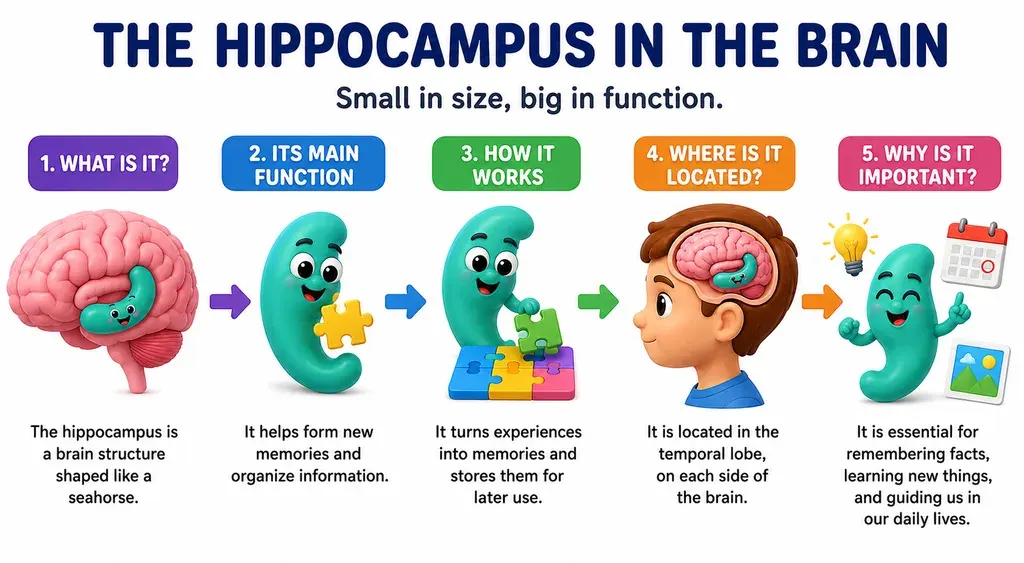
Deep in the temporal lobe, the hippocampus is the hub of memory and our spatial navigation system. Specialised neurons live inside it:
- Place cells: they fire only when we are in one specific physical space, mapping our surroundings in real time.
- Grid cells: they act as an internal metric system that helps us calculate distances and coordinates.
The moment of the «reset»: the contextual boundary
When you walk down the hallway and cross a door, the environment changes abruptly: light, temperature, acoustics and visual perspective all shift within milliseconds. At that exact instant:
- Change detection: the hippocampus’s place cells identify a new scene and send an alert to the prefrontal cortex.
- Event boundary: the brain reads the previous «chapter» (being in the living room) as finished and a new one (being in the bedroom) as begun.
- Data dump: to avoid attentional overload and save energy, the prefrontal cortex «flushes the buffer». The brain assumes the data from the previous setting is no longer a priority and frees up space to process the possible stimuli or risks of the new space.
Did you know? This phenomenon is not limited to brick-and-mortar structures. In the digital age, jumping from one browser tab to another or switching apps on your smartphone triggers exactly the same mental wiping mechanism.
Stress and tiredness as modern amplifiers
The doorway effect happens to everyone, but modern life can multiply how often it strikes:
- Lack of sleep: fatigue builds up adenosine and weakens connections in the prefrontal cortex, making short-term memory extremely volatile.
- Stress and cortisol: under pressure, the adrenal glands release cortisol. The brain switches to survival mode and prioritises hypervigilance over secondary tasks such as remembering where we left an object.
A survival guide for the threshold
Although this is a natural adaptive mechanism, three simple strategies can soften its effects:
- Say your goal out loud: saying «I’m going for the charger» before you stand up helps anchor the thought through a double trace (motor and auditory).
- Carry a tactile cue: if you are heading to the kitchen for water, take the empty glass with you. The physical stimulus keeps the intention active.
- Avoid multitasking: if you cross the doorway while checking a message or chewing over a worry, working memory will saturate and the reset becomes inevitable.
Next time your mind goes blank after crossing a threshold, don’t get frustrated. It is not a system failure, but proof that you have a hyper-efficient brain working at full capacity to adapt to a world in constant change.
References and scientific support
- The doorway effect experiment. Radvansky, G. A., Krawietz, S. A., & Tamplin, A. K. (2011). Walking through doorways causes forgetting: Further explorations. Quarterly Journal of Experimental Psychology, 64(8), 1632-1645. Read the study on PubMed
- Event boundaries and segmentation. Zacks, J. M., & Swallow, K. M. (2007). Event segmentation. Current Directions in Psychological Science, 16(2), 80-84. Read the study on PubMed Central
- Working memory and the prefrontal cortex. Baddeley, A. (2003). Working memory: looking back and looking forward. Nature Reviews Neuroscience, 4(10), 829-839. Read the study on PubMed
- Place cells in the hippocampus. O’Keefe, J., & Nadel, L. (1978). The Hippocampus as a Cognitive Map. Oxford University Press. Read the full book on UCL Discovery (PDF)
- The impact of stress on attention. Arnsten, A. F. T. (2009). Stress signalling pathways that impair prefrontal cortex structure and function. Nature Reviews Neuroscience, 10(6), 410-422. Read the study on PubMed Central
We're building the space for you to comment on the articles.
Continue reading

Procrastination and the limbic hijack
Neuroscience shows that procrastination is not a lack of willpower or organisation, but a defence mechanism for regulating frustration

The (harmful) obligation to socialize
Why forcing extroversion wears down the nervous system, and why protecting your mental energy is an act of health

The infinite scroll trap
What happens in your brain when you fall into the short-video loop