Bioelectricity: can voltage cure cancer?
The tissues of the human body coordinate their anatomy through voltage. What if cancer were, in fact, a problem of electrical communication?
Before your brain had its first thought, the cells in your body were already communicating with electricity. We tend to associate electric currents exclusively with lightning, power sockets or neurons. Yet the trillions of cells that make up your body are, in fact, tiny living batteries.
For decades, biology has treated the genome as the organism’s definitive, unalterable blueprint but, in the laboratories of Tufts University, the biologist Michael Levin has demonstrated a fascinating reality: DNA is barely a catalogue of materials —the set of instructions for making the proteins we are built from— while the guide that determines where each organ goes and how the body should organize itself is a living network of electric charges and voltages.
The electrical memory of development
Imagine being able to change a cell’s fate without modifying its DNA, simply by altering its voltage. That is exactly what Levin’s team achieved in its experiments with embryos of the frog Xenopus laevis. By altering the flow of ions across the membrane of a group of gut cells, they managed to emit a precise electrical signal without touching a single gene. The result was that those cells received the order to build a complete, functional eye in the middle of the belly.
The most astonishing part was that the modified cells «convinced» their unaltered neighbours to collaborate in building the structure. Healthy cells communicate continuously through tiny intercellular hatches —the communication tunnels known as gap junctions— exchanging small charged particles to agree on the boundaries and anatomy of each organ.
The voltage of health (and the tumour’s «deafness»)
Cancer does not begin solely with a faulty gene, but with an electrical blackout that isolates the cell from the tissue’s network.
Every cell in our body works through ionic gradients. They have tiny gates in their membranes called ion channels that pump charged particles in and out (such as sodium, potassium or calcium), generating a difference in charge, or membrane potential. As long as a group of cells maintains its healthy voltage, it stays connected to the neighbourhood assembly through its communication tunnels, cooperating so that the body works in harmony.
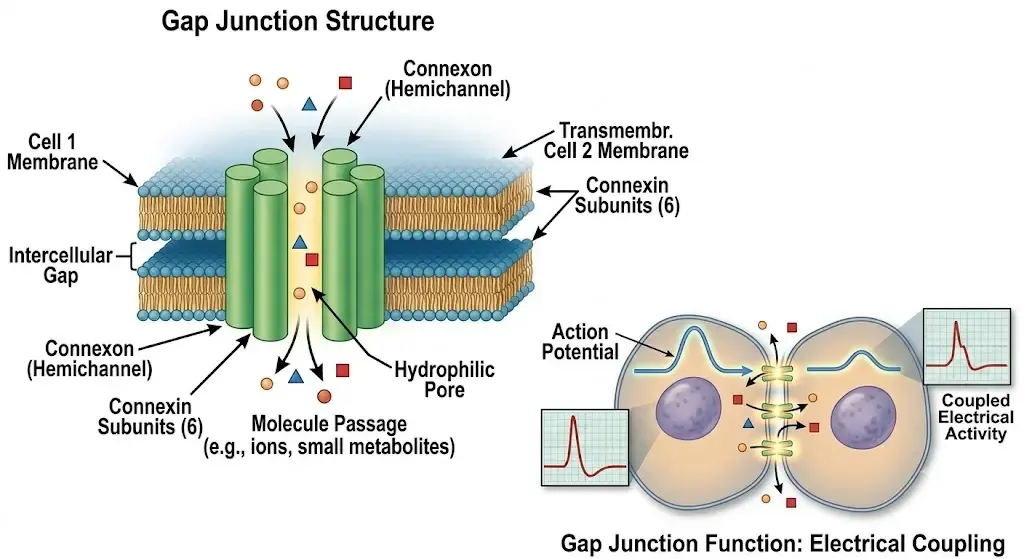
What happens when cancer appears? Levin’s team discovered that the tumour begins with a failure in this electrical balance. Tumour cells undergo a drastic alteration: they lose their usual difference in charge and depolarize. As this voltage is lost, the gap junctions slam shut. The cell is trapped in a kind of «electrical deafness», isolated from the rest of the tissue. In that disconnected state, it forgets that it belongs to a larger organ and reverts to primitive, selfish behaviour: dividing without control and hoarding the resources around it.
The spark that reverses the disease
By restoring a tumour cell’s natural voltage, it starts listening to the body’s orders again and the tumour is reabsorbed, even while keeping its genetic mutations.
Conventional medicine has spent more than a century trying to fight cancer by destroying diseased cells with chemotherapy or by attempting to correct their genetic mutations. Levin decided to try a radically different approach: instead of killing the cell or altering its genes, he set out to restore its electrical communication network.
In its research with animal models, the team introduced oncogenes —aggressive cancer-causing genes—. When the tumours began to grow, they did not use destructive drugs. They simply applied compounds that reopened the tumour cells’ ion channels, easing the passage of ions in order to give them back their original membrane voltage.
The result was spectacular. On recovering their healthy voltage, the cancer cells reopened their communication tunnels (gap junctions), reconnected to the tissue’s network and went back to obeying the body’s orders. The tumour was simply reabsorbed and reintegrated as healthy tissue. What is more, they discovered something striking: the genetic mutations were still there in the DNA, but had been completely neutralized by the restoration of bioelectric balance.
The future of medicine: electroceuticals
This discovery profoundly changes the medical paradigm. It opens the door to the era of «electroceuticals»: medical devices designed to regulate cellular electrical gradients, direct organ regeneration or halt complex diseases. Curiously, this kind of therapy is already used to treat hypertension or heart conditions, since its therapeutic target is precisely the ion channels.
Michael Levin’s research invites us to understand biology through the laws of physics and electric charge. Cancer could stop being seen as an inevitable sentence dictated by faulty genes and instead be understood as a problem of disconnection in the cells’ electrical network; a voltage imbalance that, if we learn to regulate it, we can bring back to normal.
References and scientific support
- Bioelectric induction of ectopic organs. Pai, V. P., Aw, S., Shomrat, T., Lemire, J. M., & Levin, M. (2012). Transmembrane voltage potential controls embryonic eye patterning in Xenopus laevis. Development, 139(2), 313-323. Read the study on PubMed
- Bioelectric reprogramming and prevention of cancer. Chernet, B. T., & Levin, M. (2013). Transmembrane voltage potential of somatic cells controls oncogene-mediated tumorigenesis at long range. Oncotarget, 4(9), 1460-1473. Read the study on Oncotarget
- The morphogenetic code and bioelectricity (general review). Levin, M. (2021). Bioelectric signaling: Reprogrammable circuits underlying embryogenesis, regeneration, and cancer. Cell, 184(8), 1971-1989. Read the article on Cell
We're building the space for you to comment on the articles.
Continue reading

Science under coercion
mRNA, the freedom at stake and the consent nobody asked for

Sunlight against H. pylori
How UVB radiation and vitamin D3 switch on the natural defenses that fight this gastric pathogen
Blue blocker glasses
The optical shield that protects you from the artificial light wrecking your biology