Science under coercion
mRNA, the freedom at stake and the consent nobody asked for

During the pandemic, the premise of «free choice» was blown apart by an unprecedented social and institutional blackmail. Today, while the registries reveal a worrying rise in fast-progressing tumours, the industry that grew rich demands silence. But the memory of the coercion we lived through forces an uncomfortable question: are we, as citizens, ready to defend our freedom against the business of the big corporations and the health alerts still to come?
The illusion of consent
We were told that vaccination was a voluntary act. Recent memory, however, contradicts the official version. During the COVID-19 pandemic, society experienced an unprecedented form of biopolitical coercion: health passes, travel restrictions and bans on entering public premises, media stigmatisation of the unvaccinated, and even the direct threat of losing one’s job. The ethical principle of informed consent —a cornerstone of modern medicine since the Nuremberg Code— was reduced to a fiction. Millions of people went to be vaccinated, not after an individual, conscious weighing of risks and benefits, but under the pressure of not becoming economic and social pariahs.
That absence of freedom is all the graver in light of the independent scientific findings that keep emerging. One example is the recent study Potential Oncogenicity of Synthetic mRNA Vaccines: Convergent Mechanistic, Clinical, and Population Evidence for a Concurrent-Hit Model of Accelerated Malignancy (Catanzaro et al., 2026). That work —one of many that inspired this article— compiles and analyses a set of converging signals spanning molecular mechanisms, clinical cases and population mortality data.
Studies like this one show that the warnings about the potential serious adverse effects of mRNA vaccines are not «conspiracy theories», but scientific hypotheses grounded in rigorous data. With this evidence on the table, the citizen should today be freer than ever to decide which path to take when it comes to their own body. Health cannot be a mandate imposed by the State or by corporate pressure, but a sovereign decision of each individual.
The «turbo-cancer» phenomenon
In oncology clinics in several countries a pattern has been described that departs from the classic behaviour of the disease: tumours presenting directly at stage IV, aggressive relapses in patients who had been in remission for years, progressions measured in weeks rather than years. These are scattered clinical observations, with no case definition and no registry to collect them, and in the independent literature they have been given the name «turbo-cancer».
It is worth saying from the outset what this is and what it is not. It is not a recognised diagnosis nor an established fact, but a signal that somebody ought to study seriously. The concurrent-hit model proposed by Catanzaro and his team attempts to explain it: against conventional tumour development —decades of accumulated mutations— the mRNA platform in lipid nanoparticles (LNPs) could land several biological «hits» at once, grouped into four routes.
- The accelerator: activation of growth receptors such as EGFR and of the STAT3-MYC pathway, with clonal expansion of cancer stem cells.
- The brakes: interference with tumour-suppressor genes such as p53 and with the BRCA1/2 repair genes.
- The surveillance: alterations in T lymphocytes and in the interferon response that would reduce the ability to detect and eliminate latent micro-tumours.
- The material: residual plasmid DNA —including SV40 promoter sequences— encapsulated in the LNPs, with the attendant risk of genotoxicity.
The hypothesis is built on in vitro findings and case series, not on epidemiology: the step from «Spike does this in a cell culture» to «vaccines accelerate tumours in people» has not been taken, and Catanzaro’s work is a preprint that has yet to pass peer review. Its value lies not in demonstrating harm, but in pointing to questions the initial trials left open. And an open question about a product administered to billions of people under pressure is already reason enough for what follows.
The risk that is documented
To find harm there is no need to reach for any hypothesis. It is enough to read what the regulators themselves admitted while the campaign was still running.
In April 2022, a cohort study published in JAMA Cardiology followed 23.1 million residents of Denmark, Finland, Norway and Sweden and quantified the excess of myocarditis and pericarditis in the 28 days after vaccination: between 4 and 7 cases per 100,000 with Comirnaty (Pfizer/BioNTech) and between 9 and 28 per 100,000 with Spikevax (Moderna). The risk was concentrated in young men and was more marked after the second dose.
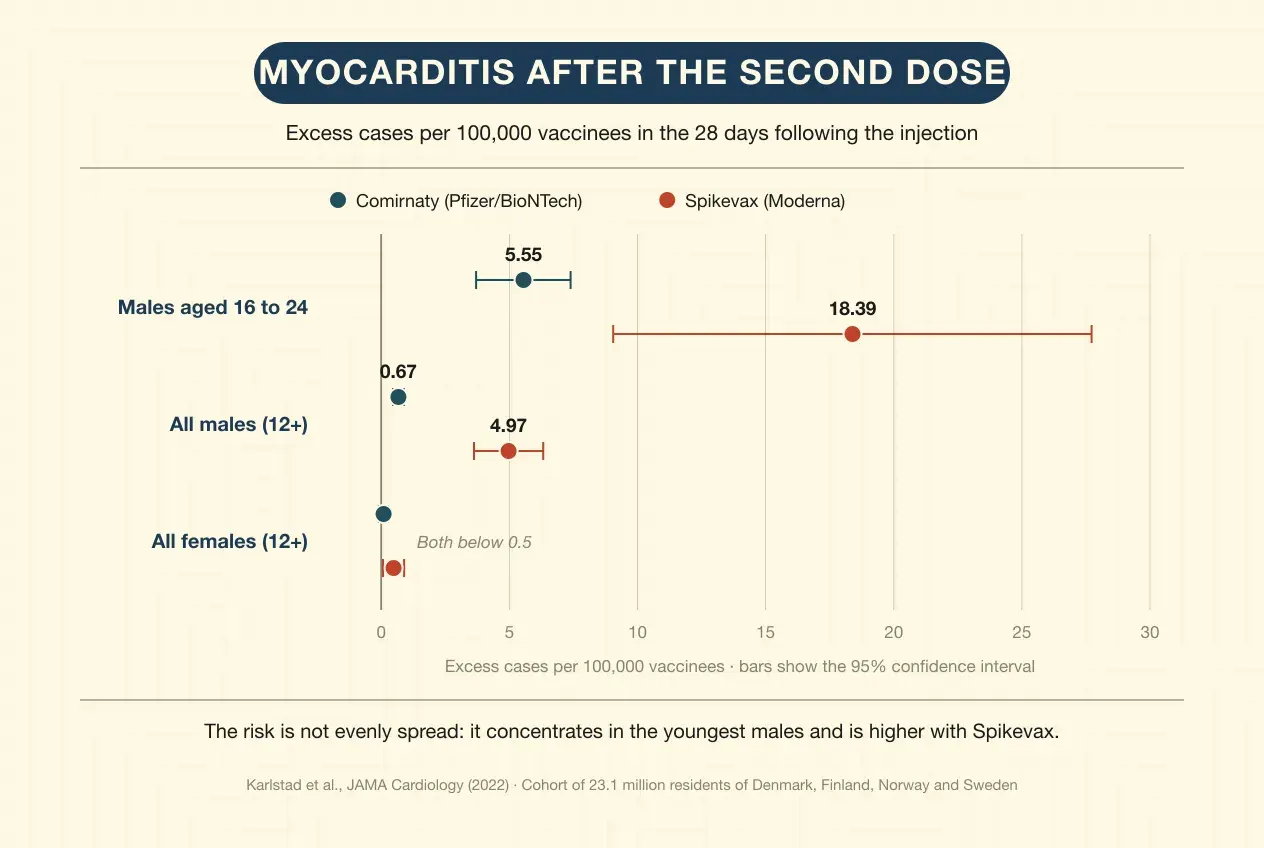
This was neither a marginal nor a late finding. Back in October 2021, with the preliminary data from that same Nordic registry on the table, Sweden, Denmark, Finland and Norway restricted or suspended the use of Spikevax in the under-30s. Four European states concluded that, for that particular group, the risk-benefit balance did not add up.
And here is what matters: those same states —and many others that restricted nothing— were at that moment maintaining health passes, access restrictions and workplace pressure on that very demographic. Young men were being coerced into taking a product that was, in parallel, being withdrawn from them as a precaution.
There is no need to go further. A drug with a known risk profile, acknowledged by its own regulators and unevenly distributed depending on who receives it, is exactly the kind of product that cannot be imposed. That the risk is small in absolute terms does not change the argument: the question is not how large it is, but who decides to take it on. And that decision can belong only to whoever provides the body.
The Big Pharma empire and regulatory capture
That four countries acted on that signal and most did not forces us to look at the economic and political context in which the pharmaceutical industry operates, and in which such decisions are taken —or left untaken.
1. Legal immunity and record profits
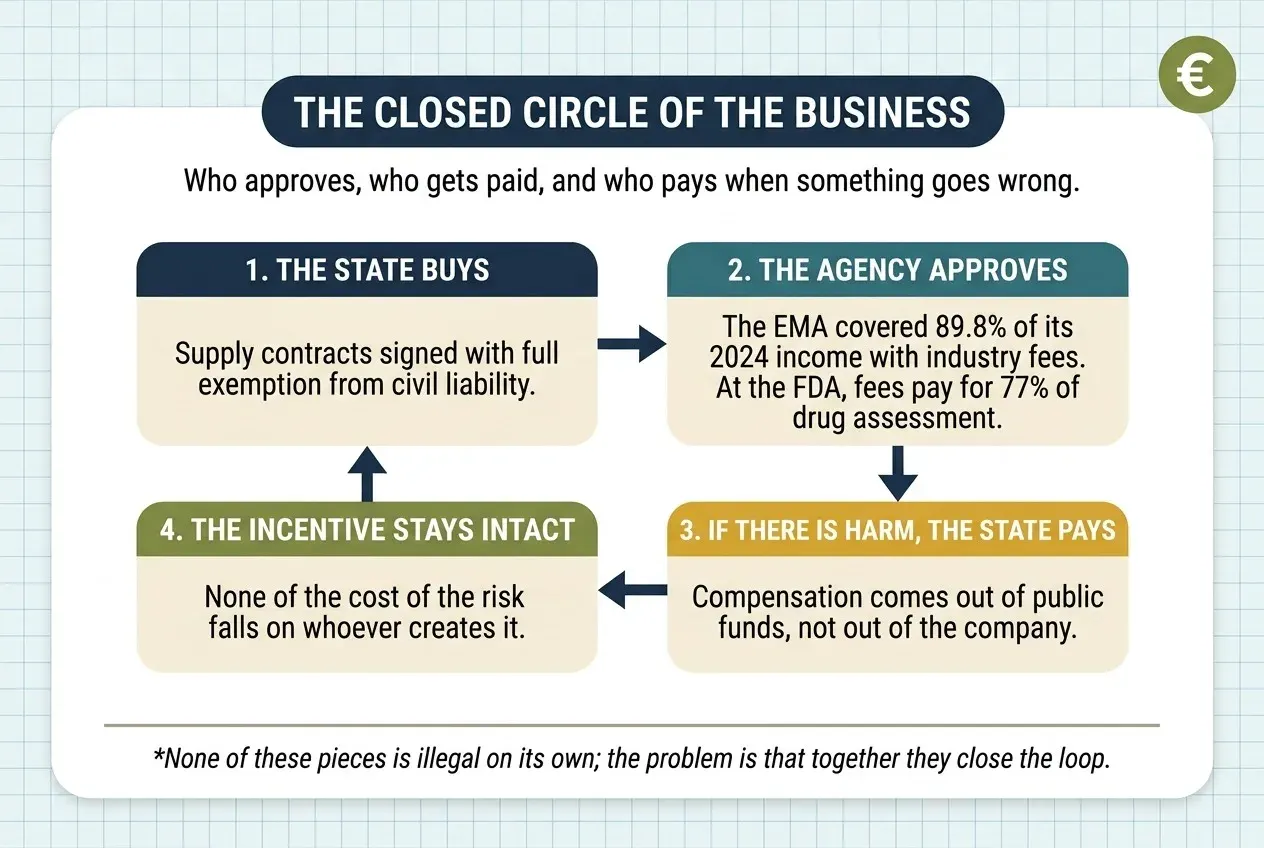
Pharmaceutical corporations signed supply contracts that required full exemption from civil liability. If a product causes harm or an accelerated cancer, the company bears no cost: the compensation funds come out of the public purse. Meanwhile, the net profits recorded reached astronomical figures.
2. Captured regulatory agencies
Bodies such as the FDA and the EMA obtain a substantial part of their operating funds through the fees the pharmaceutical companies themselves pay to have their products assessed. This economic relationship creates a perverse incentive structure: the agencies run the risk of acting more as commercial partners in speeding up approvals than as independent arbiters of public health.
3. The perpetual market cycle
Having promoted mRNA technology for pandemic prevention, the same multinationals are now investing billions in applying that very platform to treat cancer through «therapeutic vaccines». What takes shape is a damaging commercial loop: a biological vehicle whose structural flaws may contribute to the development of pathologies is subsequently sold as the solution to those same diseases.
The battle that concerns us
Beyond the molecular debates or the statistical disputes, the mRNA vaccine crisis lays bare a fundamental lesson about power, freedom and human dignity.
The large pharmaceutical corporations and economic conglomerates operate under an implacable logic: maximising profit at any cost. They will use all their financial muscle, their influence over the media and their ties to political institutions to protect their assets and expand their markets. Faced with this, the responsibility for protecting the future cannot rest with boards of directors or with captured regulatory committees, but with citizens themselves.
During the pandemic we witnessed one of the most tragic phenomena of modern society: the collapse of organic solidarity and the emergence of a climate of accusation and social coercion. The population split, pointing the finger at the neighbour, the workmate or the relative who chose to exercise sovereignty over their own body. Civil society became, voluntarily, the enforcing arm of state and corporate pressure.
We urgently need to reflect: what will happen when these same corporations and international bodies declare the next emergency or the next pandemic? Will we make the same mistakes again? Will we once more accept that fundamental rights be suspended, that divergent scientific data be silenced, and that whoever doubts be punished, in exchange for a false promise of safety?
Conclusion
If the history of science and of civil liberties teaches us anything, it is that no public or private entity holds absolute truth, least of all in an environment shot through with multi-billion-euro economic interests and political agendas. Genuine science is not built on censorship, dogma or government slogans; science advances thanks to open debate, independent scrutiny, constant replication and the inescapable right to ask uncomfortable questions.
Science is not a dogma to be obeyed under coercion; it is an exercise in constant questioning. It is time to awaken critical thinking, lift the censorship and reclaim freedom.
References and scientific support
- The preprint proposing the concurrent-hit model and cataloguing 35 oncogenic mechanisms. Catanzaro, J. A., Hulscher, N., Stricker, R. B., Waselenko, J. K., & McCullough, P. A. (2026). Potential Oncogenicity of Synthetic mRNA Vaccines: Convergent Mechanistic, Clinical, and Population Evidence for a Concurrent-Hit Model of Accelerated Malignancy. Zenodo. View the preprint on Zenodo
- The multi-hit hypothesis applied to SARS-CoV-2 vaccination. Valdes Angues, R., & Perea Bustos, Y. (2023). SARS-CoV-2 vaccination and the multi-hit hypothesis of oncogenesis. Cureus, 15(12), e50703. View study on PubMed Central
- The Spike protein is not inert: on its own it activates cell signalling pathways in human cells. Suzuki, Y. J., & Gychka, S. G. (2021). SARS-CoV-2 spike protein elicits cell signaling in human host cells: implications for possible consequences of COVID-19 vaccines. Vaccines, 9(1), 36. View study on PubMed
- The innate-immunity suppression hypothesis: G-quadruplexes, exosomes and microRNAs. Seneff, S., Nigh, G., Kyriakopoulos, A. M., & McCullough, P. A. (2022). Innate immune suppression by SARS-CoV-2 mRNA vaccinations: The role of G-quadruplexes, exosomes, and MicroRNAs. Food and Chemical Toxicology, 164, 113008. View study (DOI)
- N1-methylpseudouridine makes the ribosome slip and produce unintended proteins. Mulroney, T. E., Pöyry, T., Yam-Puc, J. C., et al. (2024). N1-methylpseudouridylation of mRNA causes +1 ribosomal frameshifting. Nature, 625(7993), 189-194. View study (DOI)
- Quantifying residual plasmid DNA and SV40 promoter sequences in commercial vials. Speicher, D. J., Rose, J., & McKernan, K. (2025). Quantification of residual plasmid DNA and SV40 promoter-enhancer sequences in Pfizer/BioNTech and Moderna modRNA COVID-19 vaccines from Ontario, Canada. Autoimmunity, 58(1), 2551517. View study on PubMed
- Vaccine mRNA and Spike antigen persist in lymph node germinal centres for up to eight weeks after injection. Röltgen, K., Nielsen, S. C. A., Silva, O., et al. (2022). Immune imprinting, breadth of variant recognition, and germinal center response in human SARS-CoV-2 infection and vaccination. Cell, 185(6), 1025-1040.e14. View study (DOI)
- The class switch toward non-inflammatory IgG4 antibodies after repeated vaccination. Irrgang, P., et al. (2023). Class switch toward noninflammatory, spike-specific IgG4 antibodies after repeated SARS-CoV-2 mRNA vaccination. Science Immunology, 8(79), eade2798. View study on PubMed Central
- The lipid component of LNPs is inflammatory on its own in preclinical models. Ndeupen, S., et al. (2021). The mRNA-LNP platform’s lipid nanoparticle component used in preclinical vaccine studies is highly inflammatory. iScience, 24(12), 103479. View study (DOI)
- The excess of myocarditis and pericarditis quantified in 23.1 million people: the basis for the Nordic restrictions. Karlstad, Ø., Hovi, P., Husby, A., et al. (2022). SARS-CoV-2 vaccination and myocarditis in a Nordic cohort study of 23 million residents. JAMA Cardiology, 7(6), 600-612. View study on PubMed Central
We're building the space for you to comment on the articles.
Continue reading
The contagion dilemma
The hidden hypothesis about the origin of pandemics, the role of exosomes and environmental medicine
Bioelectricity: can voltage cure cancer?
The tissues of the human body coordinate their anatomy through voltage. What if cancer were, in fact, a problem of electrical communication?

Sunlight against H. pylori
How UVB radiation and vitamin D3 switch on the natural defenses that fight this gastric pathogen