The spectrum of AI and the map of power
Three kinds of systems, three geopolitical poles and the struggle between open models and the closed giants

When the public or the media say “AI”, they tend to speak as if they meant a single technological monolith, an all-knowing entity that works to one pattern. Yet in today’s computer engineering, lumping together a content recommendation algorithm, a photorealistic synthesis tool and an autonomous system able to run a supply chain is a deep analytical mistake.
Artificial intelligence is not a finished product but a vast spectrum of mathematical disciplines and software architectures that have evolved dramatically. To grasp the real scope of this revolution, we need to bring some order to this technological zoo: to understand which categories of systems exist, which laboratories and geopolitical interests drive their development, and what it means for society whether their code is kept under lock and key or opened to public scrutiny.
Types of artificial intelligence
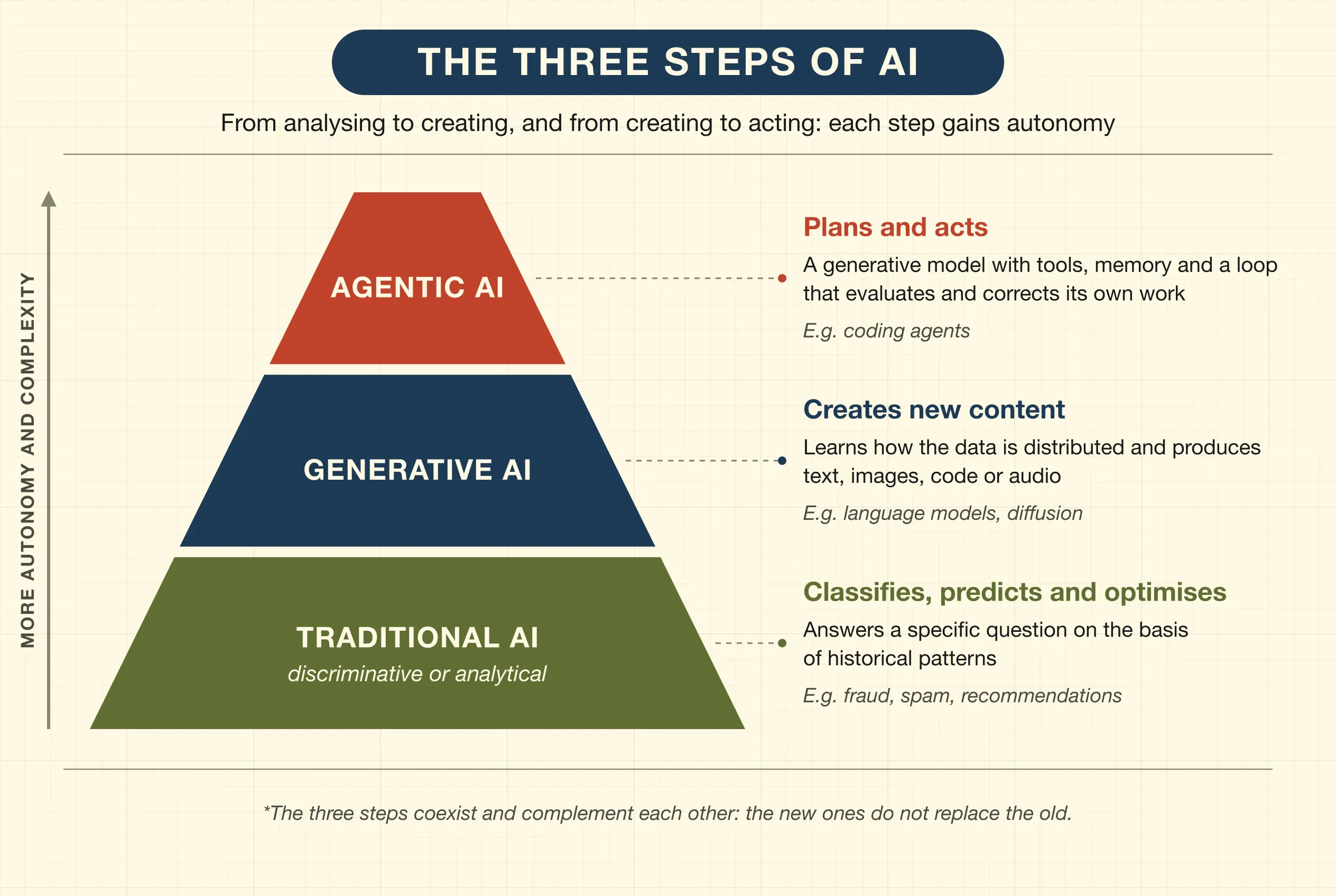
Behind the label lies a discipline with more than seventy years of history, and still expanding. To bring some order to it, we can sort today’s systems into three broad evolutionary steps according to their degree of autonomy and structural complexity. They do not replace one another: they coexist and complement each other.
Traditional AI
Discriminative or analytical AI is the historical foundation on which modern data analytics was built. These systems do not create original content; their purpose is to classify, predict and optimise on the basis of structured historical patterns.
- How it works: it uses statistical regression models, decision trees or classic neural networks to give a deterministic or probabilistic answer to a specific question: is this transaction fraudulent? What will the temperature be tomorrow?
- Examples: the algorithms that detect fraudulent transactions on your credit card, weather forecasting systems, email spam filters, or the recommendation engines of Spotify and Netflix. They are highly efficient tools, but they lack any flexibility outside their specific domain.
- Metaphor: it is like an expert inspector on an assembly line who, after seeing thousands of parts, can instantly tell the faulty one from the sound one according to strict rules.
Generative AI
The great cultural phenomenon of this decade. Unlike discriminative AI, which analyses the existing world, generative AI learns the underlying statistical distribution of the data in order to produce new content: text, images, programming code or audio.
- How it works: given an instruction (the prompt), it relies on probabilistic architectures to build a plausible response. A language model works out which word is likely to come next, over and over, until it has put together a coherent piece of writing; an image model starts from random noise and refines it step by step until an image emerges that matches the description.
- Examples: writing text with language models, creating images through latent diffusion, or generating snippets of code.
- Metaphor: a virtuoso jazz musician who has mastered every scale and every genre of the past, able to improvise a new and coherent melody whenever asked, even without emotionally understanding the pain or joy it evokes.
Agentic AI
This is the operational frontier of technological development. It is no longer about an AI responding to a one-off prompt in a chat window, but about giving the model autonomy, memory and the capacity to plan.
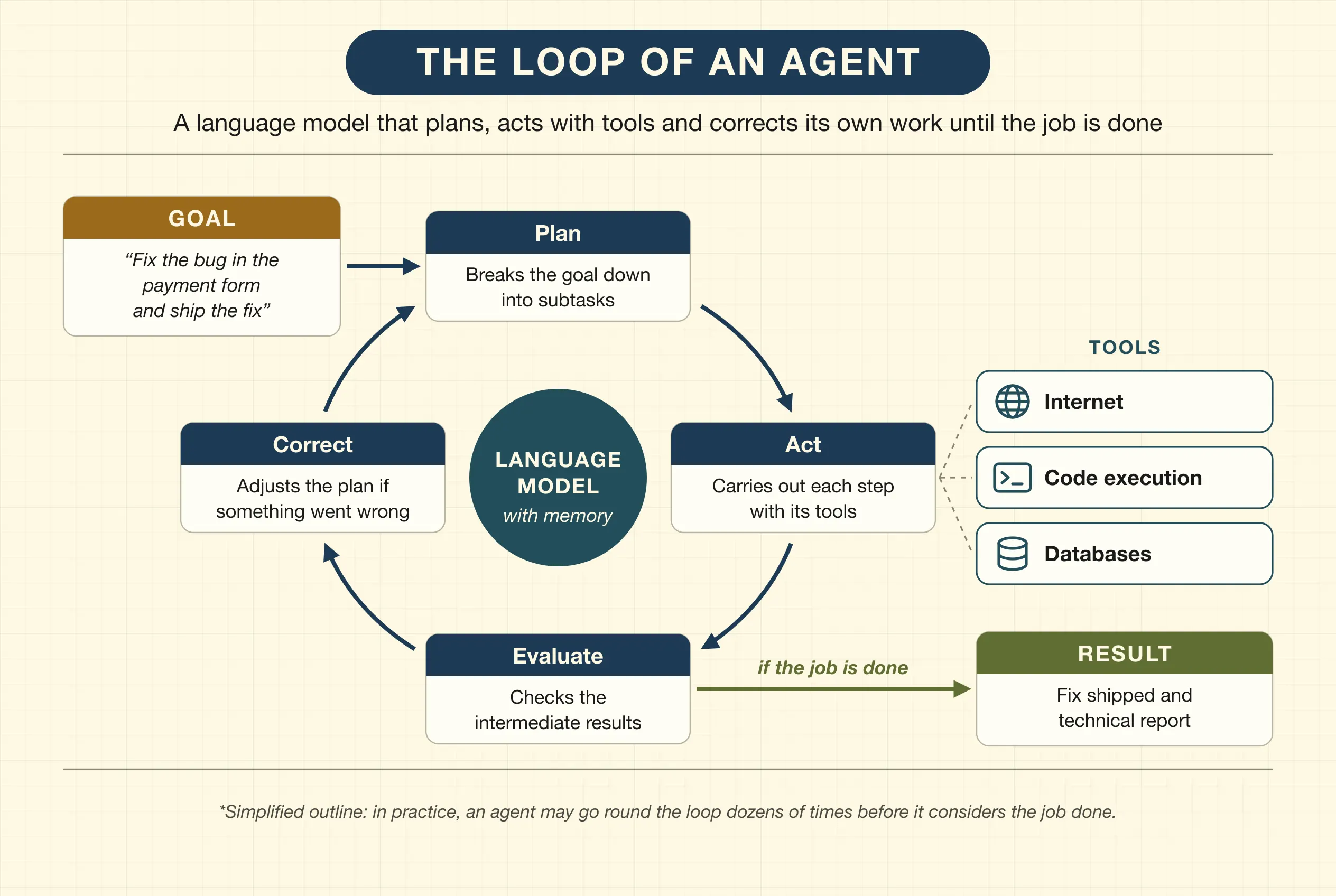
- How it works: it combines a generative language model with a set of external tools (internet access, code execution, databases) and an iterative reasoning loop. The agent receives a high-level goal, breaks it down into subtasks, carries out actions, evaluates the intermediate results and corrects its own mistakes until the job is done.
- Examples: coding assistants able to audit entire codebases, fix bugs, deploy the result to servers and write the technical report without constant human intervention.
- Fundamental limit: long-term reliability, and handling uncertainty when they face real-world scenarios their design did not anticipate.
While discriminative AI seeks precision in analysis and generative AI plausibility in synthesis, agentic AI introduces functional agency: it closes the loop between computational thought and action in the real world.
The map of global power
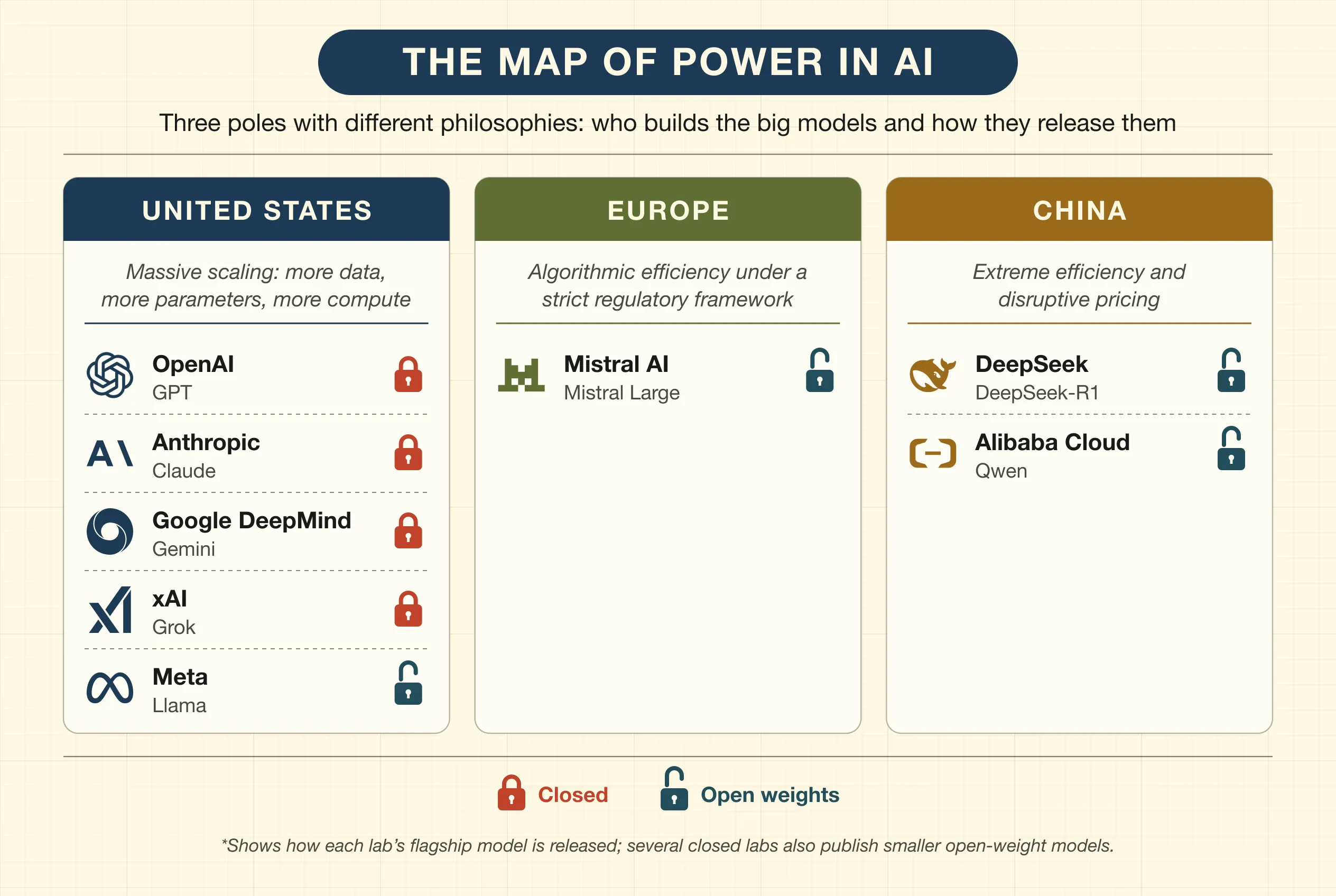
Just as twentieth-century geopolitics was shaped by control of oil and sea routes, the twenty-first century is defined by sovereignty over advanced silicon, data and algorithmic talent. Today the global AI ecosystem is organised around three major poles, with radically different philosophies, incentives and business models.
The Silicon Valley axis
The United States is still home to the commercial giants pushing the limits of raw performance, generally with closed models.
- Philosophy: a bet on massive scaling (the so-called scaling laws). The premise is simple: the more data, the more parameters and the more computing power (GPUs), the more capable the model becomes.
- Business model: close to a platform monopoly. Multi-billion investments from venture capital and the large technology companies (Big Tech), monetised through consumer subscriptions and proprietary APIs for businesses.
Key players
- OpenAI: the great commercial catalyst of the modern era, thanks to its GPT series and its strategic alliance with Microsoft.
- Anthropic: founded by former OpenAI employees, it stands out for its Claude family of models and for placing safety and ethical alignment at the centre of its development.
- Google DeepMind: the scientific powerhouse par excellence. Behind milestones such as AlphaFold, which predicts the three-dimensional structure of proteins from their sequence and earned its creators the 2024 Nobel Prize in Chemistry, it channels its research muscle into the Gemini ecosystem.
- xAI: Elon Musk’s venture with its Grok model, characterised by direct integration with real-time data and less restrictive content filters.
Europe
Europe competes from an unusual position: with far less investment in computing capacity than the United States or China, it has opted for research excellence and algorithmic efficiency.
- Philosophy: maximise performance per parameter, prioritising models that can run on local or European infrastructure, under the umbrella of a strict regulatory framework (the Artificial Intelligence Act, or AI Act).
- Business model: unable to afford competing with the American giants in building the world’s largest supercomputers, the European ecosystem specialises in optimisation. It develops lightweight, flexible, multilingual architectures that deliver excellent performance for a fraction of the computational and energy cost.
Key player
- Mistral AI: Europe’s great standard-bearer. Based in Paris, it has shown that it is possible to compete among the global elite with efficient models, many of them with open weights, that rival the American ones while using a fraction of their compute.
Asia (mainly China)
Asia has reshaped the board with disruptive advances that challenge the idea that progress can only be bought with multi-billion budgets.
- Philosophy: extreme efficiency, reinventing training methods to cut resource consumption drastically, and agility in mass adoption.
- Business model: open or very low-cost models that break the pricing of Western monopolies and bring frontier capabilities within reach of emerging economies.
Key players
- DeepSeek: the great disruptor. In early 2025 it shook the industry with R1, an open-weight reasoning model that performed on a par with the best Western laboratories for a drastically lower training investment.
- Alibaba Cloud: it develops the Qwen family, one of the most powerful, multilingual and versatile open-weight options in the world, covering text processing, computer vision and advanced programming.
Closed models versus open-weight models
Within the software ecosystem there is a technical and philosophical debate as intense as the geopolitical one: the tension between closed models and open-weight models.
This divide defines the real battlefield of the present: a tug of war between the concentration of cognitive power in the hands of a handful of transnational corporations and its decentralisation as a digital public good.
Proprietary (closed) models
These are models whose technical internals, source code and neural weights remain strict trade secrets. Users interact with them only through applications or programming interfaces (APIs).
- Advantages: the highest level of safety, managed by the provider; direct technical support; extreme optimisation for the end consumer; and large investments in ethical alignment.
- Drawbacks: total dependence on an external provider (vendor lock-in), opacity about how the training data was processed, and exposure to unilateral changes in terms of service or pricing.
Open-weight models
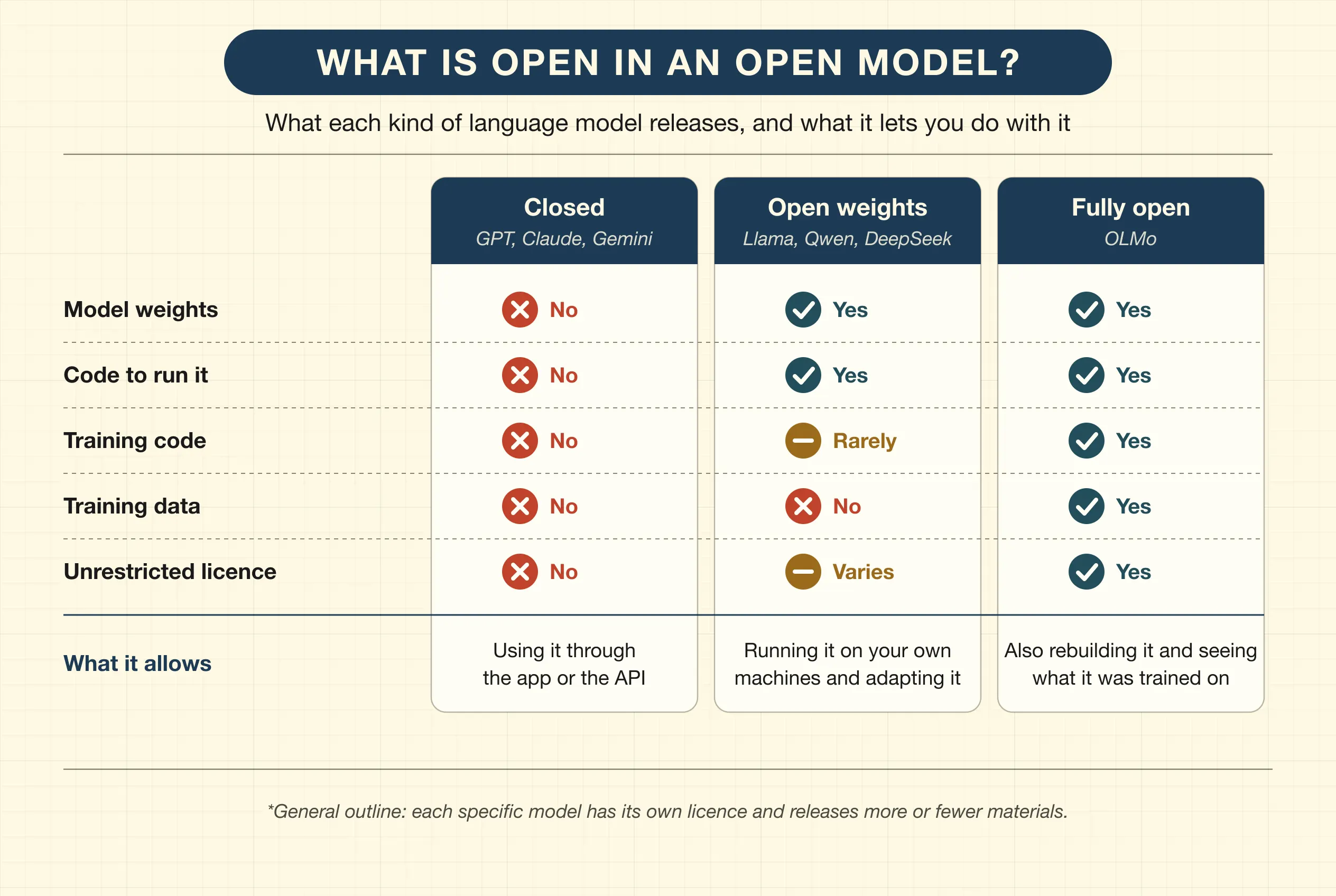
These are models whose neural weight files are published so that any researcher, company or citizen can download, audit, modify and run them on their own hardware. The most notable standard-bearer of this philosophy has been Meta’s Llama family.
- Advantages: full sovereignty over the data, the option of local customisation (fine-tuning) without private information leaving the organisation’s servers, scientific auditability, and resistance to corporate or government censorship.
- Drawbacks: they require advanced technical skills to deploy and maintain, and their safety barriers can be removed, which makes malicious uses easier if they are not handled responsibly.
Open weights should not be confused with open source. What gets published are the parameters of the already trained model, but almost never the data or the code it was trained with, and the licences often restrict certain uses. An open-weight model can be run and adapted, but not rebuilt from scratch. There are also fully open models, such as OLMo from the Allen Institute for AI, which release their training data and code as well, but they are the exception.
Summary table
| Feature | Proprietary (closed) models | Open-weight models |
|---|---|---|
| Access to the internals | Hidden behind a commercial application or API. Users only consume the service. | The neural weights can be freely downloaded to study or modify them. |
| Control and privacy | Data travels to third-party servers, subject to their retention policies. | They run locally or on your own servers: full sovereignty over the data. |
| Safety and moderation | Rigid filters built in by the manufacturer (commercial alignment). | They can be customised and even have their alignment removed; users take responsibility for ethical use. |
| Running costs | Pay per use (tokens processed through the provider’s API). | The cost of your own infrastructure (hardware, GPUs) or of renting servers in the cloud. |
| Notable examples | GPT-6.1 Terra (OpenAI), Claude Opus 5.5 (Anthropic), Gemini 4 Carbon (Google). | Llama 4 (Meta), Qwen (Alibaba), Mistral Large (Mistral AI). |
A brief reflection
The rise of open-weight models is a fundamental counterweight to monopolies, in favour of technological democracy. If the scientific knowledge of artificial intelligence were confined to the sealed servers of three or four multinational corporations, society would lose the ability to audit, regulate and adapt these tools to specific local, scientific or social needs.
Open models act as a digital public good: they let universities, hospitals, small businesses and independent developers experiment, audit biases and build tailored solutions without depending on the blessing of a single commercial provider.
References and scientific support
- The classic distinction between the two approaches: a discriminative model learns to separate the classes; a generative one, how the data of each class is distributed. Ng, A. Y., & Jordan, M. I. (2001). On discriminative vs. generative classifiers: A comparison of logistic regression and naive Bayes. Advances in Neural Information Processing Systems, 14, 841-848. View study at NeurIPS
- How Netflix’s recommender works inside, told by the people in charge of it, and what it is worth to the business. Gomez-Uribe, C. A., & Hunt, N. (2015). The Netflix recommender system: Algorithms, business value, and innovation. ACM Transactions on Management Information Systems, 6(4), 13. View paper (DOI)
- The report that coined the term “foundation models”: general systems trained at scale and then adapted to specific tasks. Bommasani, R., Hudson, D. A., Adeli, E., Altman, R., Arora, S., … & Liang, P. (2021). On the opportunities and risks of foundation models. arXiv, 2108.07258. View study on arXiv
- Latent diffusion: generating an image by removing noise step by step, in a compressed space that makes the computation cheaper. Rombach, R., Blattmann, A., Lorenz, D., Esser, P., & Ommer, B. (2022). High-resolution image synthesis with latent diffusion models. Proceedings of the IEEE/CVF Conference on Computer Vision and Pattern Recognition (CVPR), 10674-10685. View study (DOI)
- The pattern many agents follow: alternating reasoning with tool actions, and correcting the plan with what they return. Yao, S., Zhao, J., Yu, D., Du, N., Shafran, I., Narasimhan, K., & Cao, Y. (2023). ReAct: Synergizing reasoning and acting in language models. International Conference on Learning Representations (ICLR). View study on arXiv
- A review of agents built on language models: planning, memory, tool use and their limits. Wang, L., Ma, C., Feng, X., Zhang, Z., Yang, H., Zhang, J., Chen, Z., Tang, J., Chen, X., Lin, Y., Zhao, W. X., Wei, Z., & Wen, J. (2024). A survey on large language model based autonomous agents. Frontiers of Computer Science, 18(6), 186345. View paper (DOI)
- The scaling laws: a language model’s performance improves predictably as parameters, data and compute increase. Kaplan, J., McCandlish, S., Henighan, T., Brown, T. B., Chess, B., … & Amodei, D. (2020). Scaling laws for neural language models. arXiv, 2001.08361. View study on arXiv
- The refinement of those laws: for the same compute budget, it pays to train smaller models on far more data. Hoffmann, J., Borgeaud, S., Mensch, A., Buchatskaya, E., Cai, T., … & Sifre, L. (2022). Training compute-optimal large language models. Advances in Neural Information Processing Systems, 35, 30016-30030. View study on arXiv
- AlphaFold: predicting protein structure with accuracy close to that of experiment. Jumper, J., Evans, R., Pritzel, A., Green, T., Figurnov, M., … & Hassabis, D. (2021). Highly accurate protein structure prediction with AlphaFold. Nature, 596(7873), 583-589. View paper (DOI)
- The figures behind the global split: how many notable models come from the United States, China and Europe, and how the gap between them is narrowing. Maslej, N., Fattorini, L., Perrault, R., Gil, Y., Parli, V., … & Oak, S. (2025). Artificial Intelligence Index Report 2025. Stanford Institute for Human-Centered Artificial Intelligence. View report on arXiv
- The European AI regulation, which classifies systems by risk and sets obligations for general-purpose models. European Parliament and Council of the European Union. (2024). Regulation (EU) 2024/1689 laying down harmonised rules on artificial intelligence. Official Journal of the European Union, L 2024/1689. View the text on EUR-Lex
- Mistral’s first model: with 7 billion parameters, it outperformed open models almost twice its size. Jiang, A. Q., Sablayrolles, A., Mensch, A., Bamford, C., Chaplot, D. S., … & El Sayed, W. (2023). Mistral 7B. arXiv, 2310.06825. View study on arXiv
- How DeepSeek trained a frontier model with a fraction of the usual compute. DeepSeek-AI. (2024). DeepSeek-V3 technical report. arXiv, 2412.19437. View report on arXiv
- DeepSeek-R1: step-by-step reasoning obtained through reinforcement learning and released with open weights. Guo, D., Yang, D., Zhang, H., Song, J., Wang, P., Zhu, Q., … & Zhang, Z. (2025). DeepSeek-R1 incentivizes reasoning in LLMs through reinforcement learning. Nature, 645(8081), 633-638. View paper (DOI)
- Alibaba’s Qwen3 family: open-weight models, from small to very large, in more than a hundred languages. Yang, A., Li, A., Yang, B., Zhang, B., Hui, B., … & Qiu, Z. (2025). Qwen3 technical report. arXiv, 2505.09388. View report on arXiv
- The first Llama: competitive models trained on public data alone and made available to the research community. Touvron, H., Lavril, T., Izacard, G., Martinet, X., Lachaux, M.-A., … & Lample, G. (2023). LLaMA: Open and efficient foundation language models. arXiv, 2302.13971. View study on arXiv
- What each “open” model actually releases: most share the weights, but not the training data or code. Liesenfeld, A., & Dingemanse, M. (2024). Rethinking open source generative AI: Open washing and the EU AI Act. Proceedings of the 2024 ACM Conference on Fairness, Accountability, and Transparency, 1774-1787. View study (DOI)
- OLMo: a fully open model, released with its data, training code and logs so that anyone can study and reproduce it. Groeneveld, D., Beltagy, I., Walsh, E., Bhagia, A., Kinney, R., Tafjord, O., … & Hajishirzi, H. (2024). OLMo: Accelerating the science of language models. Proceedings of the 62nd Annual Meeting of the Association for Computational Linguistics, 15789-15809. View study (DOI)
- Why openness is not enough to decentralise AI while compute, data and talent remain concentrated in a few companies. Widder, D. G., Whittaker, M., & West, S. M. (2024). Why ‘open’ AI systems are actually closed, and why this matters. Nature, 635(8040), 827-833. View paper (DOI)
- The benefits and risks of open models, measured against what closed models and other technologies already allow. Kapoor, S., Bommasani, R., Klyman, K., Longpre, S., Ramaswami, A., … & Narayanan, A. (2024). On the societal impact of open foundation models. Proceedings of the 41st International Conference on Machine Learning, PMLR 235, 23082-23104. View study at PMLR
We're building the space for you to comment on the articles.
Continue reading

The heart in the skin
How ultraviolet radiation releases the skin's nitric oxide to regulate blood pressure and fight cardiovascular risk

The Zeigarnik effect, or the cost of having brilliant ideas
The psychological phenomenon that sabotages your rest in the name of creativity

Structured water: the terrain of health
The liquid battery in your cells, and how to protect it from the modern environment