The one and only
Why environment, diet and freedom dictate the true richness and nutritional density of the egg
What if the perfect multivitamin existed? With a flawless biological design, protected by a sealed, oval structure capable of isolating its contents from the assaults of the outside world, this marvel of evolution is none other than the egg. Packed with protein of the highest quality, healthy fats, critical vitamins and essential minerals, this small capsule of highly bioavailable nutrients is Mother Nature’s original and definitive nutritional pill.
The nutritional time capsule
For millennia, the egg has been one of the fundamental pillars on which human evolution was built. Our hunter-gatherer ancestors competed with other predators to reach the nests of wild birds, knowing instinctively that the golden treasure inside amounted to a shot of energy, noble fats and immediate vitality.
In the last decades of the 20th century, however, this ancestral food suffered one of the greatest smear campaigns in the history of medicine. On the strength of flawed studies, it was accused of clogging our arteries. Millions of people cut their consumption to historic lows, replacing it with industrial options loaded with sugars and refined oils.
Today, modern science has fully acquitted the egg and, in fact, we know that its nutrients protect the body. But just as we regain our trust in it, we run into a new reality: there is no longer just one kind of egg. Behind the identical appearance of the shells lies an abysmal nutritional and ethical gap.
The industrialisation of the egg
To feed a massive urban population, the agri-food industry took a drastic and unnatural decision in the middle of the last century: to detach the animal from the land and apply the principles of assembly-line production to living beings. This process of ultra-efficiency turned farms into protein factories, putting volume and low cost above any other biological variable.
By shutting animals up in artificial environments and standardising their diet with compound feed, the industry not only altered their natural behaviour but radically changed the biochemical composition of the food itself. Calling this food production is a euphemism; it is a true biological aberration. And what most of us buy in supermarkets today is the result of this hyper-industrialised system.
The aberration of codes 2 and 3
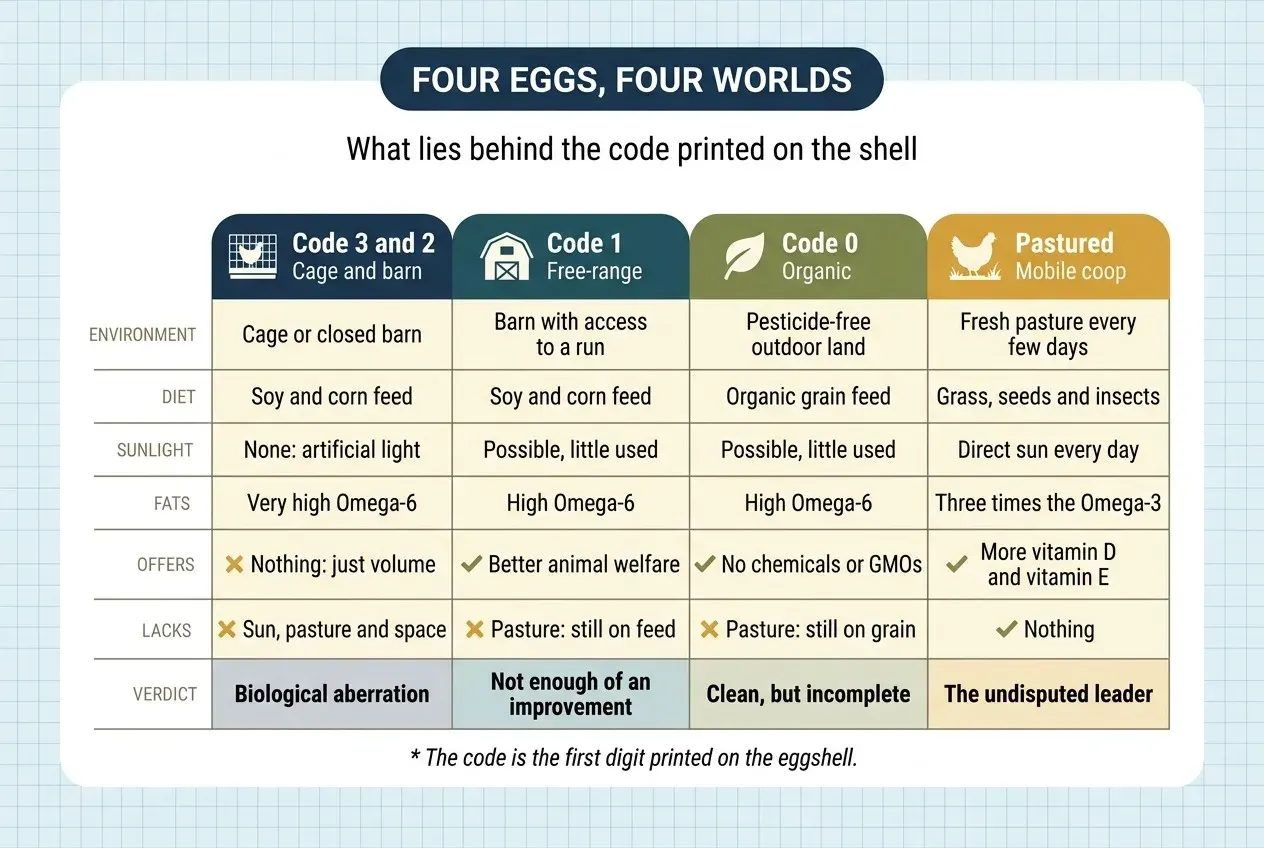
In the European Union, this model hides behind the printed codes 3 (caged hens) and 2 (hens on the floor of closed barns).
Under the code 3 system, the birds spend their short existence confined in wire cages where each animal has barely the space of an A4 sheet of paper. They can never fully stretch their wings, scratch the earth or establish their natural pecking order.
Under code 2, the cages disappear, but the overcrowding moves into colossal industrial sheds where tens of thousands of hens compete in a constant artificial gloom, breathing an atmosphere saturated with ammonia from their own droppings.
This radical disconnection from their habitat destroys the bird’s metabolic health. A chronically stressed and inflamed hen cannot produce a healthy food. The resulting egg is the reflection of her misery: a product with a biologically impoverished yolk.
Fed exclusively on soy- and corn-based feed, their fats are thrown completely out of balance. The result is an egg artificially high in linoleic acid (Omega-6), with a ratio to Omega-3 that often exceeds 10:1. Eating this lipid profile day after day feeds our body’s inflammatory pathways, the very opposite of what we would look for in a nutrient-dense food.
The great colour fraud
There is a myth deeply rooted in the consumer’s subconscious: «If the yolk is a deep, vibrant orange, the egg comes from the countryside and the hen has been happy». The advertising industry knows this bias perfectly well and has designed one of the most brilliant and silent optical illusions in the food sector.
In the industrial sheds of codes 2 and 3, the hens never see a blade of grass or a ray of sunshine. Left to nature, then, their eggs would have a pale yellow yolk, almost translucent and visually unappealing to the buyer.
To solve this, the corporations turn to chemistry by way of the feed. They add synthetic colouring additives or concentrated extracts —such as canthaxanthin— to the birds’ diet. There is even a commercial catalogue (the yolk colour fan) from which producers can choose exactly the shade of orange they want their eggs to have the following month.
This dietary «make-up» hides the nutritional poverty of the product. The orange of an industrial egg is an empty shell: pure aesthetics with no biochemical backing. When a genuine yolk is orange, by contrast, it is because the animal has accumulated real beta-carotenes through the massive intake of green shoots and fresh plants. The industry sells us the look of health, stripped of health itself.
The labyrinth of labels
When consumers decide to flee the industrial aberration, they usually seek refuge in the two regulated categories that promise greater animal welfare: free-range eggs and organic ones. While they represent an unquestionable step forward for animal rights, their real nutritional differences tend to be misunderstood.
Free-range eggs (code 1)
This code certifies that the hens have access to an open-air outdoor run during daylight hours, with a regulated density of at least 4 square metres per bird. It is an undeniable relief in husbandry terms. On the strictly nutritional plane, however, the difference is not as drastic as people think.
The reason? Although the hens can go out, the great majority of their daily diet still comes from the same silo of conventional feed (soy and corn) located inside the barn. They go on eating a high amount of Omega-6 polyunsaturated fats, and their nutritional profile rises only subtly compared with barn hens.
Organic eggs (code 0)
Here the regulatory bar rises considerably, but not in the direction most people imagine. The true value of the organic label lies in purity and environmental safety.
The feed these hens eat must be 100 % certified organic, free of genetically modified organisms (GMOs), and no synthetic pesticides, herbicides or chemical fertilisers are allowed on the outdoor land. The rules also ban the preventive use of antibiotics.
The organic egg is the top choice if what we want is to shield our body against traces of endocrine disruptors and chemical contaminants, but metabolically it still shares the structural base of grain feed.
The photobiological factor: sunlight
There is one critical element that modern nutrition often forgets, and that sets housed animals irreconcilably apart from free ones: sunlight.
Hens, like human beings, are photobiological organisms. Their skin and feathers react to the ultraviolet B (UVB) radiation of the solar spectrum. When the sun’s rays strike the bird, they trigger a cascade of endogenous synthesis that converts lipid precursors into active vitamin D3. This vitamin does not simply stay in the hen’s body to keep her bones strong; being a fat-soluble hormone, the animal concentrates it as a priority in the yolk of her eggs to ensure the best possible development of her hypothetical offspring.
A code 2 or 3 hen spends her life under fluorescent tubes or LED bulbs that completely lack the UVB spectrum. Free-range hens, although they have access to the outdoors, often spend much of the day inside the sheltering barn, close to the main feeder.
The industry makes up for this shortfall by adding synthetic vitamin D to the feed. Yet biochemistry persistently shows that industrial supplementation of the animal does not match the transfer of natural D3 synthesised under the sun. Biochemical analyses reveal that eggs from birds continuously exposed to real sunlight contain between 3 and 4 times more active vitamin D than any egg from an intensive farm. Eating these eggs is, quite literally, eating sunshine in liquid form.
The undisputed leader: the egg from pastured hens
We reach the peak of nutritional quality. The concept of pastured hens, not to be confused with the term «free-range», is not a mere label granted by some authority; it is a dynamic model of feeding and biological behaviour.
On a true pasture farm, the farmers do not just open a door so the hens can step out onto a yard of beaten earth. They use mobile coops that are moved periodically —every few days— to fresh sections of land covered in living vegetation. This completely transforms the bird’s existence and the biochemistry of her egg:
- The living diet: on entering a new pasture, the hens express their purest ancestral behaviour. They eat tender shoots of grass, wild legumes, seeds and, crucially, a massive quantity of insects, worms and larvae. This intake of living animal protein provides micronutrients that will never be found in a sack of feed.
- The rebirth of Omega-3s: fresh grass is extraordinarily rich in alpha-linolenic acid (plant Omega-3). Thanks to their massive consumption of pasture, pastured hens change the fat profile of their yolk. Levels of inflammatory polyunsaturated fats fall drastically, while Omega-3s triple. This puts the Omega-6/Omega-3 ratio at an optimal 3:1 or 4:1. It is the exact lipid profile our species evolved with, designed to switch cellular inflammation off rather than fan it.
- The antioxidant shield: thanks to real green shoots, the pastured yolk accumulates massive levels of vitamin E (up to twice that of a conventional egg) and beta-carotenes. These antioxidants not only protect the delicate fatty structures of the yolk itself from oxidising during cooking, but act as powerful cell protectors in our own body, benefiting our eye health (thanks to lutein and zeaxanthin) and cardiovascular health.
The egg from pastured hens thus stands as the undisputed leader. It is not just an egg produced in cleaner surroundings or with more room to move; it is a qualitatively superior food, a dense nutritional medicine and, no less importantly, a way of respecting nature and the dignity of the animals that sustain us.
Conclusion
Understanding the superiority of the pastured egg forces us to look up from the plate. This model of rearing not only represents the summit of human nutrition, but aligns with one of the most transformative movements of our century: regenerative agriculture.
Industrial confinement destroys the soil through the toxic build-up of nitrogen. Rotational grazing does exactly the opposite: the hens act as healers of the land. Their feet scratch and aerate the ground naturally. As they feed, they clear the field of pests and harmful insects and remove weeds with no need for chemical pesticides.
The most magical part happens after they leave: their droppings fertilise the soil organically. The pasture grows back with infinitely greater vigour and biodiversity. The land recovers its capacity to hold water and capture carbon from the atmosphere.
Buying and eating eggs from pastured hens is not a mere dietary whim. It is a conscious vote for a living ecosystem. It means understanding that the health of the soil determines the health of the plant; the health of the plant dictates that of the animal; and that of the animal, inevitably, seals our own.
Seeking out the ancestral egg, the one and only, is the wisest act of nutritional rebellion we can carry out today. Going back to the origin is not going backwards; it is reclaiming the future of our health.
References and scientific support
- The egg’s acquittal: across three large cohorts and a meta-analysis, eating up to one egg a day was not associated with higher cardiovascular risk. Drouin-Chartier, J.-P., Chen, S., Li, Y., Schwab, A. L., Stampfer, M. J., Sacks, F. M., Rosner, B., Willett, W. C., Hu, F. B., & Bhupathiraju, S. N. (2020). Egg consumption and risk of cardiovascular disease: three large prospective US cohort studies, systematic review, and updated meta-analysis. BMJ, 368, m513. View study (DOI)
- The minimum conditions for each rearing system: 750 cm² per hen in an enriched cage, of which only 600 are usable, and up to nine hens per square metre in barns. Council of the European Union (1999). Council Directive 1999/74/EC of 19 July 1999 laying down minimum standards for the protection of laying hens. Official Journal of the European Communities, L 203, 53-57. View text on EUR-Lex
- What an egg must meet to be sold as «free-range», starting with 4 m² of outdoor land per hen. European Commission (2023). Commission Delegated Regulation (EU) 2023/2465 of 17 August 2023 as regards marketing standards for eggs. Official Journal of the European Union, L, 2023/2465. View text on EUR-Lex
- Canthaxanthin as an authorised additive for pigmenting the yolk: up to 8 mg per kilo of feed for laying hens. EFSA Panel on Additives and Products or Substances used in Animal Feed (FEEDAP) (2014). Scientific opinion on the safety and efficacy of canthaxanthin as a feed additive for poultry and for ornamental birds and ornamental fish. EFSA Journal, 12(1), 3527. View opinion (DOI)
- On the same feed, hens exposed to sunlight laid eggs with three to four times more vitamin D3 in the yolk than those kept indoors; free-range eggs bought in supermarkets, by contrast, held little of it. Kühn, J., Schutkowski, A., Kluge, H., Hirche, F., & Stangl, G. I. (2014). Free-range farming: A natural alternative to produce vitamin D-enriched eggs. Nutrition, 30(4), 481-484. View study (DOI)
- Compared with caged sister hens, those grazing legumes and grasses laid eggs with twice the vitamin E, 2.5 times more total Omega-3 and less than half the Omega-6/Omega-3 ratio. Karsten, H. D., Patterson, P. H., Stout, R., & Crews, G. (2010). Vitamins A, E and fatty acid composition of the eggs of caged hens and pastured hens. Renewable Agriculture and Food Systems, 25(1), 45-54. View study (DOI)
- Pastured eggs had three times the Omega-3 and twice the carotenoids of cage-free eggs, with an Omega-6/Omega-3 ratio five to ten times lower; taking corn and soy out of the feed also halved the Omega-6. Sergin, S., Jambunathan, V., Garg, E., Rowntree, J. E., & Fenton, J. I. (2022). Fatty acid and antioxidant profile of eggs from pasture-raised hens fed a corn- and soy-free diet and supplemented with grass-fed beef suet and liver. Foods, 11(21), 3404. View study on PubMed Central
- An independent, non-peer-reviewed sampling of fourteen pastured flocks: against official USDA values, a third less cholesterol, twice the Omega-3, three times the vitamin E and seven times more beta-carotene. Long, C., & Alterman, T. (2007, October/November). Meet real free-range eggs. Mother Earth News. View article
- Lutein from eggs is absorbed better than lutein from spinach or supplements. Chung, H.-Y., Rasmussen, H. M., & Johnson, E. J. (2004). Lutein bioavailability is higher from lutein-enriched eggs than from supplements and spinach in men. The Journal of Nutrition, 134(8), 1887-1893. View study (DOI)
- A systematic review with only three human studies: more lutein in the blood and less C-reactive protein among those who eat organic eggs, evidence the authors themselves call promising but still insufficient. Mesas, A. E., Fernández-Rodríguez, R., Martínez-Vizcaíno, V., López-Gil, J. F., Fernández-Franco, S., Bizzozero-Peroni, B., & Garrido-Miguel, M. (2022). Organic egg consumption: a systematic review of aspects related to human health. Frontiers in Nutrition, 9, 937959. View study (DOI)
- A rotational grazing system with several species, hens included, that built up carbon in the soil instead of losing it. Rowntree, J. E., Stanley, P. L., Maciel, I. C. F., Thorbecke, M., Rosenzweig, S. T., Hancock, D. W., Guzman, A., & Raven, M. R. (2020). Ecosystem impacts and productive capacity of a multi-species pastured livestock system. Frontiers in Sustainable Food Systems, 4, 544984. View study (DOI)
We're building the space for you to comment on the articles.
Continue reading
Real meat vs. industrial «meat»
How intensive farming altered the biology of ruminants and turned an ancestral food into a health and environmental problem

Glycine: the forgotten building block of life
The key amino acid that slows cellular ageing, improves sleep and rebuilds your tissues from within

The truth about antioxidants
The biology behind our real defence network against oxidative stress