Glycine: the forgotten building block of life
The key amino acid that slows cellular ageing, improves sleep and rebuilds your tissues from within

We can think of the body as a building under constant renovation. Keeping the walls sound, the brain wired and the cleaning systems running takes a set of molecular bricks called amino acids. Among them, one stands out not for its size but for its ubiquity and versatility: glycine.
Its name comes from the Greek glykys (sweet), for its faintly sugary taste. Biochemistry textbooks have traditionally classed glycine as a «non-essential» amino acid, meaning our body can make it on its own. Modern science, however, is questioning that label —and proposing to call it «conditionally essential»— because most of the population lives with a chronic, subclinical glycine deficit.
An average adult can synthesise about 3 grams of glycine a day and gets roughly another 3 grams from food. But the body needs around 15 grams a day to keep up its basic regenerative work, which leaves a metabolic «black hole» of some 9-10 grams of glycine a day.
For thousands of years our ancestors closed that gap by eating the whole animal, but the modern Western diet has changed the rules of the game.
Beyond the muscles
Before looking at its structural role, it is worth knowing that glycine carries out critical biochemical tasks in the nervous system, in metabolism and in cellular detoxification:
- The brain’s handbrake (and regulator): in the central nervous system, glycine acts mainly as an inhibitory neurotransmitter. By binding to its specific receptors in the spinal cord and brainstem, it lowers neuronal excitability. In practice, this quiets mental overactivity and eases the transition into deep, restorative sleep. In the brain it also supports neural plasticity and memory.
- A shield against sugar: on the metabolic side, glycine is a powerful ally against insulin resistance and helps temper the glycaemic impact of food. It also works by inhibiting glycation: it actively competes with the body’s proteins to keep excess blood sugar from sticking to them and degrading them (a process medicine measures through glycated haemoglobin, or HbA1c).
- The engine of the master antioxidant: glycine is an essential ingredient for the body to make glutathione, regarded as the cell’s «master antioxidant». Without enough glycine, glutathione production drops, and tissues are left more exposed to oxidative stress and premature ageing.
- Liver cleaner: it takes part in the liver’s detoxification phase, binding to toxic compounds and metabolic waste to turn them into water-soluble substances the kidneys can easily excrete.
The fundamental pillar of collagen
If there is one process where glycine reigns supreme, it is the synthesis of collagen: the most abundant protein in our body, responsible for giving structure and elasticity to skin, bone, cartilage, blood vessels and tendons.
Collagen has a triple helix molecular structure, much like a rope of three tightly braided strands. For that molecular braid to be stable and compact, the body follows a strict mathematical rule: one in every three amino acids must, without exception, be glycine.
This is where its tiny size becomes its greatest superpower. With no bulky side chain —its own is a single hydrogen atom—, glycine is the only amino acid small enough to fit into the tightly packed inner core of the helix. Without enough glycine the braid warps, collagen production slows down, and connective tissue starts to lose firmness, age and turn brittle.
Glycine, collagen and vitamin C
For fibroblasts (the cells in charge of making collagen) to do their job, glycine cannot act alone: it needs a perfect synergy with vitamin C.
During collagen synthesis, the «bricks» of glycine and other amino acids are joined together. But for the collagen chains to gain firmness and take on their final shape, certain amino acids have to undergo a chemical change called hydroxylation. The job is done by specialised enzymes that run on an iron-based engine in its active state (ferrous iron).
Every time these enzymes lay a brick, the iron atom oxidises and the tool is left «switched off». This is where vitamin C comes in: acting as a powerful antioxidant, it donates an electron to the iron, «recharging its batteries» so the enzyme can keep working without stopping.
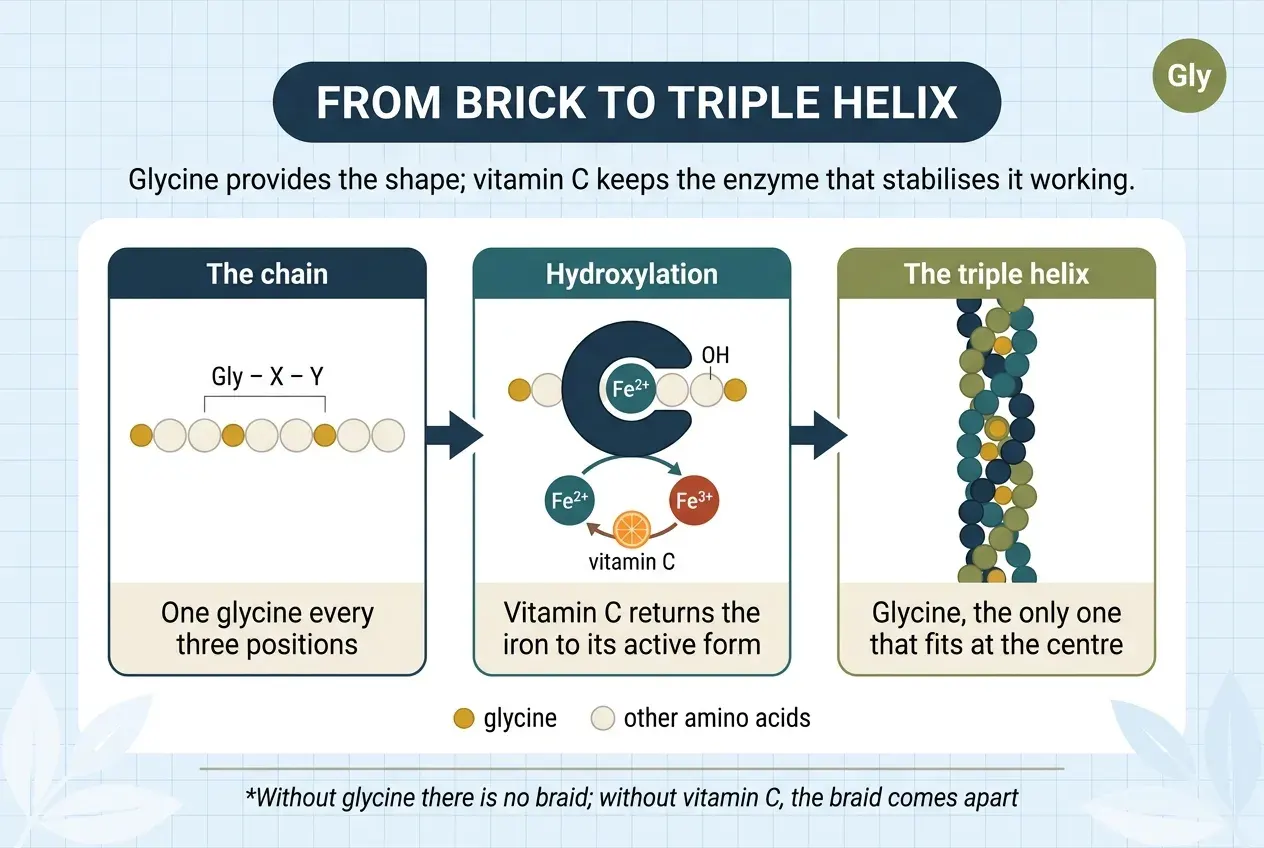
If the bricks (glycine) are missing, no structure is possible. But if the bricklayer (vitamin C) is missing, the bricks cannot be set. A historical example of that collapse is scurvy, the disease that struck eighteenth-century sailors deprived of fresh fruit: without vitamin C, collagen synthesis ground to a halt, so their gums bled, their wounds would not heal and their joints weakened.
The longevity balance
Modern Western nutrition has created a biochemical imbalance without precedent. By favouring lean meat almost exclusively (tenderloin, chicken breast, loin) and throwing away the parts rich in connective tissue, we take in large amounts of methionine —an essential amino acid abundant in animal muscle— while drastically neglecting our intake of glycine.
Metabolically, that imbalance sends a silent bill through three key biochemical pathways:
- The homocysteine cycle and vascular risk: when we process an excess of methionine, the body produces an intermediate waste product called homocysteine. If it is not neutralised in time, the molecule acts as an «arsonist» in the arteries, irritating their inner walls and raising cardiovascular risk over the long term.
- The liver’s clean-up mechanism: fortunately, the liver keeps a clean-up crew on duty to neutralise excess methionine before it wreaks havoc. The catch? That disposal system needs glycine as its fuel. Without enough glycine the machinery slows down and the waste starts to build up.
- The trick to eternal cellular youth: many studies in animal models of ageing have shown that restricting dietary methionine extends lifespan by as much as 30-40%, by reducing the production of reactive oxygen species (ROS) in the mitochondria. Drastically restricting methionine in humans, however, is complicated and impractical. This is where glycine works its magic: supplementing the diet with glycine speeds up the clearance of excess methionine, reproducing the same cellular and genetic benefits of caloric restriction without having to cut protein intake drastically.
In short, glycine is the indispensable counterweight. Striking a balance between the two amino acids is not merely a matter of eating well, but a direct strategy for cellular longevity.
Athletic performance and injury recovery
For anyone who exercises regularly or trains at high intensity, glycine is not just building material: it is a key ally for protecting the body, improving performance and speeding up recovery, through three direct mechanisms:
- Joint shield and repair: during exercise, tendons, ligaments and cartilage suffer constant wear. Since more than 80% of these tissues is made of collagen, the pace at which the body repairs them depends directly on how much glycine it has available. Keeping levels up helps regenerate battered joints and prevents nagging overuse injuries such as tendinitis.
- Cell volumisation and hydration: glycine acts as a magnet for water inside muscle cells. As it enters the muscle, it draws water in with it, producing deep hydration. Far from being mere surface water retention, this intracellular filling sends the muscle a clear signal to switch into repair mode: it stimulates the making of new proteins and reduces catabolism (muscle breakdown).
- Explosive fuel: glycine is one of the three amino acids —along with arginine and methionine— that the liver and kidneys need to make creatine. Creatine is the molecule responsible for regenerating ATP (the cell’s energy currency) during short, explosive efforts such as lifting weights or sprinting. Without enough glycine, the rate of the body’s own creatine synthesis slows down, compromising maximal strength and muscle power.
Glycine in the diet
Why didn’t our ancestors have this deficit? Because their cooking wasted nothing and made use of the whole animal. The modern diet favours lean or boneless meat, rich in other amino acids such as methionine but very poor in glycine.
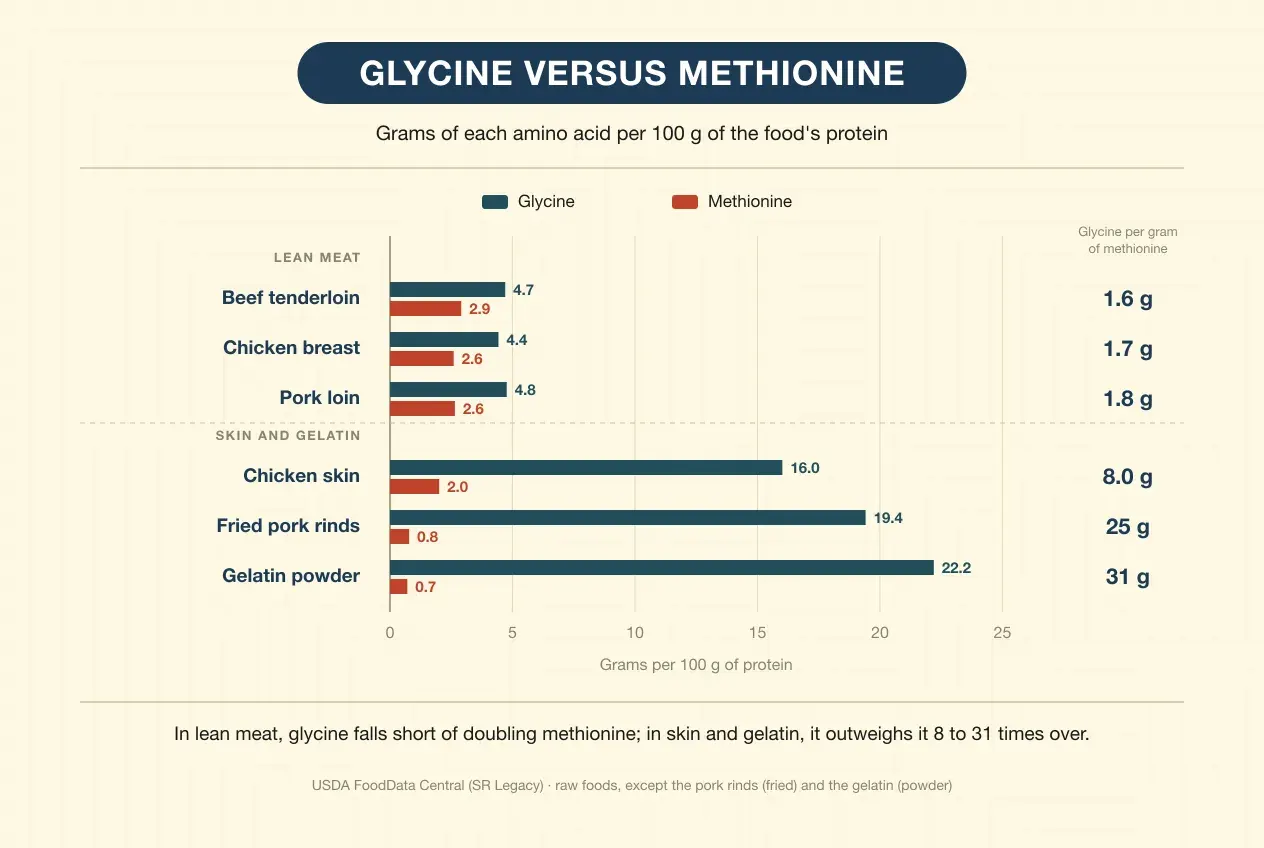
To win this nutrient back through food, the best options are:
- Traditional bone broth: slow, long simmering (12 to 24 hours) of joints and bones denatures the collagen and releases large amounts of glycine in a highly bioavailable liquid form that is easy to digest.
- Unflavoured gelatin: it is partially hydrolysed collagen, practically pure. Adding a tablespoon of unflavoured powdered gelatin to herbal teas or desserts can provide between 2 and 3 grams of glycine. It is worth pairing it with fruit rich in vitamin C to boost collagen synthesis.
- Skin, cartilage and gelatinous cuts: cuts such as beef shank, pig’s trotters, cheeks, or the skin of chicken and fish itself are goldmines of this amino acid.
- Plant-based options: although plants contain less glycine than animal connective tissue, seeds (pumpkin, sesame), nuts (peanuts, almonds), legumes (soya, lentils) and algae (spirulina) are excellent plant sources of glycine.
Conclusion
Whatever the classic textbooks say about it being «non-essential», today’s science places glycine as an indispensable piece of human architecture and longevity. Winning this nutrient back —by returning to traditional broths and cuts, through strategic supplementation, or with the simple habit of pairing it with vitamin C— is one of the simplest, cheapest and highest-impact decisions we can make to close our daily metabolic deficit, and so protect our joints, our brain and our cells against the passage of time.
References and scientific support
- The calculation that puts the body’s own glycine synthesis at about 3 g a day, leaving a deficit of some 10 g against what collagen demands. Meléndez-Hevia, E., de Paz-Lugo, P., Cornish-Bowden, A., & Cárdenas, M. L. (2009). A weak link in metabolism: the metabolic capacity for glycine biosynthesis does not satisfy the need for collagen synthesis. Journal of Biosciences, 34(6), 853-872. View study (DOI)
- Why the triple helix demands a glycine at every third position: it is the only amino acid that fits at its centre. Shoulders, M. D., & Raines, R. T. (2009). Collagen structure and stability. Annual Review of Biochemistry, 78, 929-958. View study on PubMed Central
- Vitamin C as the indispensable cofactor for hydroxylating procollagen, and how it relates to the faulty collagen of scurvy. Peterkofsky, B. (1991). Ascorbate requirement for hydroxylation and secretion of procollagen: relationship to inhibition of collagen synthesis in scurvy. The American Journal of Clinical Nutrition, 54(6 Suppl), 1135S-1140S. View study (DOI)
- In rats, adding glycine to the diet lengthens life and reproduces the effects of methionine restriction. Brind, J., Malloy, V., Augie, I., Caliendo, N., Vogelman, J. H., Zimmerman, J. A., & Orentreich, N. (2011). Dietary glycine supplementation mimics lifespan extension by dietary methionine restriction in Fisher 344 rats. The FASEB Journal, 25(S1), 528.2. View study (DOI)
- GNMT uses glycine to clear surplus methyl groups: when it is missing, SAMe soars while homocysteine stays normal. Luka, Z., Mudd, S. H., & Wagner, C. (2009). Glycine N-methyltransferase and regulation of S-adenosylmethionine levels. The Journal of Biological Chemistry, 284(34), 22507-22511. View study on PubMed Central
- In poor sleepers, 3 g of glycine at bedtime shortened the time to deep sleep and reduced daytime sleepiness. Yamadera, W., Inagawa, K., Chiba, S., Bannai, M., Takahashi, M., & Nakayama, K. (2007). Glycine ingestion improves subjective sleep quality in human volunteers, correlating with polysomnographic changes. Sleep and Biological Rhythms, 5(2), 126-131. View study (DOI)
- In sucrose-fed rats, glycine lowered blood pressure, triglycerides and abdominal fat. El Hafidi, M., Pérez, I., Zamora, J., Soto, V., Carvajal-Sandoval, G., & Baños, G. (2004). Glycine intake decreases plasma free fatty acids, adipose cell size, and blood pressure in sucrose-fed rats. American Journal of Physiology-Regulatory, Integrative and Comparative Physiology, 287(6), R1387-R1393. View study (DOI)
- Fifteen grams of vitamin C-enriched gelatin before brief exercise doubled the blood marker of collagen synthesis. Shaw, G., Lee-Barthel, A., Ross, M. L., Wang, B., & Baar, K. (2017). Vitamin C-enriched gelatin supplementation before intermittent activity augments collagen synthesis. The American Journal of Clinical Nutrition, 105(1), 136-143. View study on PubMed Central
- In older adults, glycine and cysteine supplements brought glutathione and oxidative stress back to the levels of the young. Sekhar, R. V., Patel, S. G., Guthikonda, A. P., Reid, M., Balasubramanyam, A., Taffet, G. E., & Jahoor, F. (2011). Deficient synthesis of glutathione underlies oxidative stress in aging and can be corrected by dietary cysteine and glycine supplementation. The American Journal of Clinical Nutrition, 94(3), 847-853. View study on PubMed Central
We're building the space for you to comment on the articles.
Continue reading

The truth about antioxidants
The biology behind our real defence network against oxidative stress

Vitamin B3
The currency the cell spends on its energy and on repairing its DNA