Real meat vs. industrial «meat»
How intensive farming altered the biology of ruminants and turned an ancestral food into a health and environmental problem
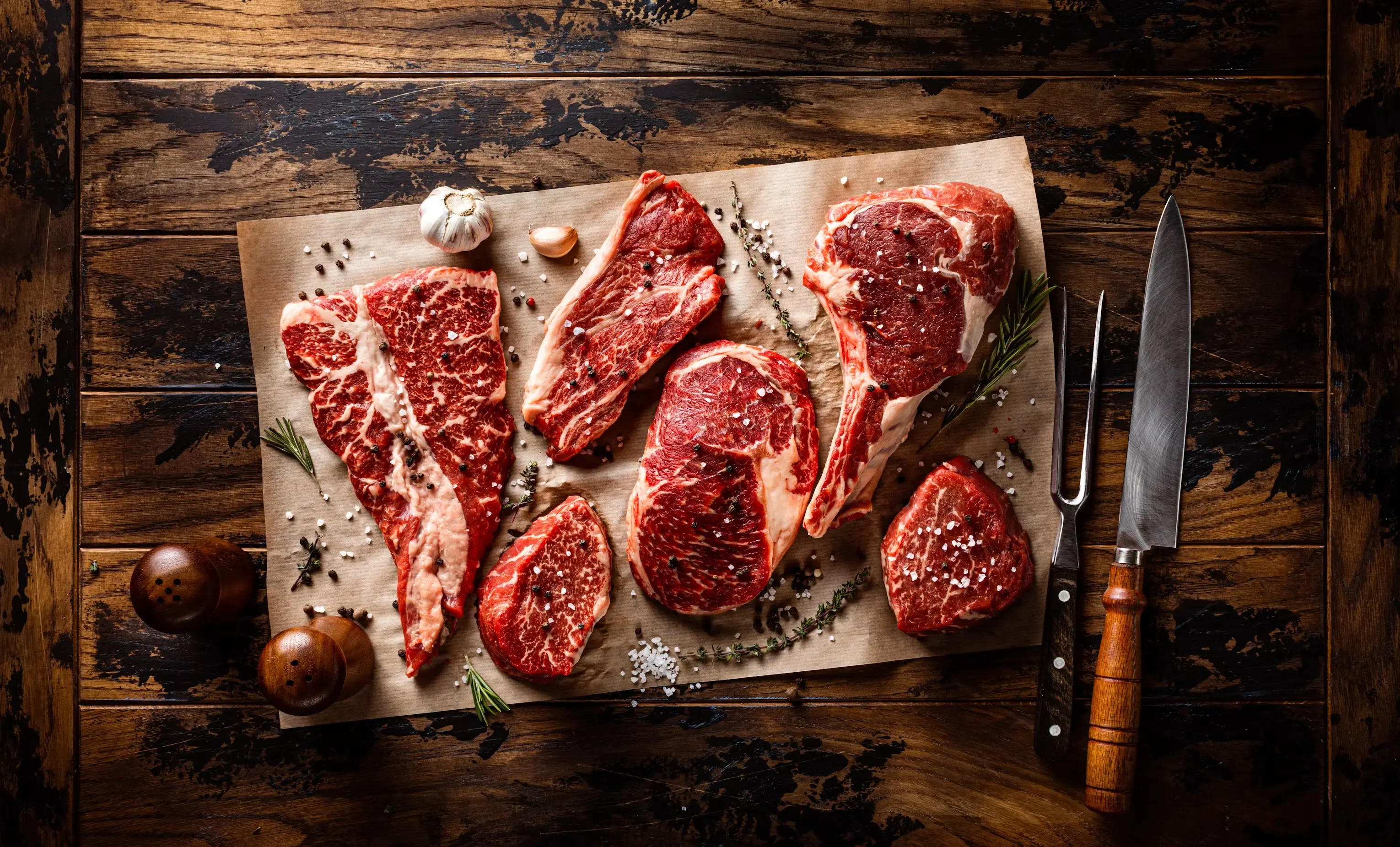
Close your eyes and picture a cow or a lamb. The image that comes to mind is probably the idyllic one: an animal grazing freely on a green hillside. Yet if you open your eyes in the chilled aisle of any supermarket, the reality is drastically different. The vast majority of the meat we eat today comes from intensive livestock farming, where thousands of animals endure life crammed into feedlots, fed on concentrated feed, cereals and soy.
For decades this agro-industrial model has prioritised growth speed and production volume over the animals’ own biology. By replacing cattle’s ancestral diet (grass, forage and leaves) with ultra-processed grain, the industry did not just alter the animals’ quality of life — it completely distorted the biochemical composition of the final product.
What we call «meat» on supermarket shelves differs substantially from the food our species evolved on. Understanding that difference is not a gastronomic whim: it matters for your health and for the planet’s.
The story hidden in animal fat
Although an industrial steak and a grass-fed one may look identical, chemical analysis tells two completely opposite stories. The critical point is not the protein, but the quality of the fat.
The balance between Omega-3 and Omega-6
Omega-3 and Omega-6 polyunsaturated fatty acids compete for the same enzymatic pathways in your body. Omega-3s reduce systemic inflammation; an excess of Omega-6 promotes it.
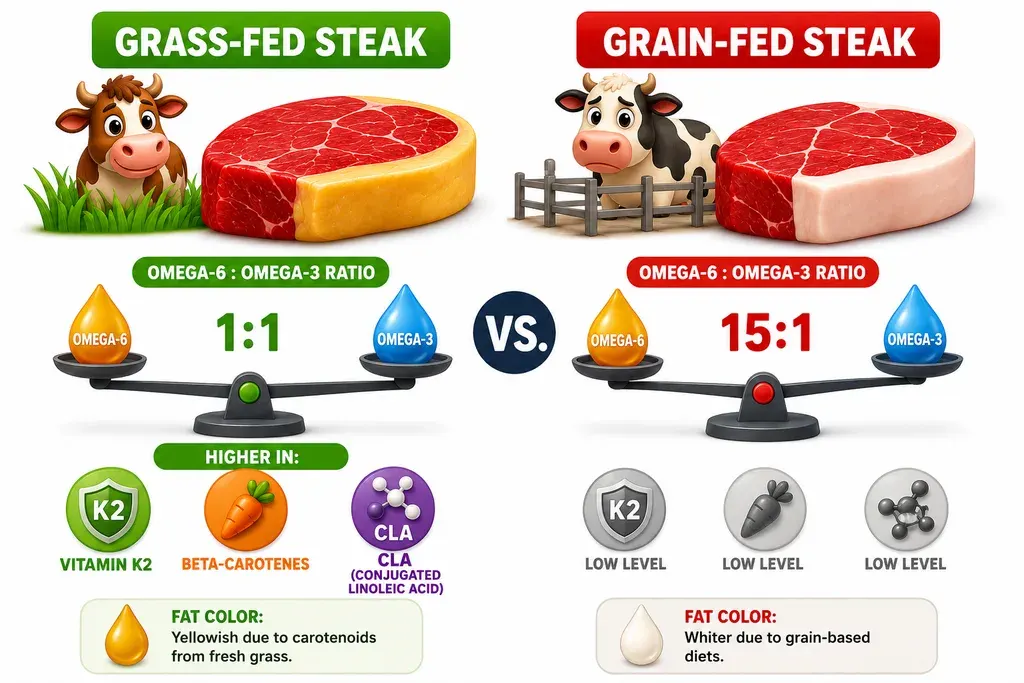
- Grass-fed meat: shows an Omega-6:Omega-3 ratio of between 1:1 and 2:1, a physiologically perfect balance.
- Industrial meat: built on feed rich in corn and soy, it reaches disproportionate ratios of up to 15:1 or 20:1, feeding the chronic inflammation that underlies most modern conditions.
Micronutrient and antioxidant density
Animals raised in the open eat dozens of different plant species rich in phytonutrients. That translates into:
- Fat-soluble vitamins: high concentrations of vitamin A (beta-carotenes), E and K2 (essential for fixing calcium in the bones and keeping it from building up in your arteries).
- Key antioxidants: far higher levels of glutathione and superoxide dismutase than feedlot meat.
- Conjugated linoleic acid (CLA): a fatty acid with powerful immunomodulatory and metabolic properties, present at levels up to 300 % higher in 100 % grass-fed ruminants.
A storm in the rumen: stress, acidosis and resistant bacteria
To grasp the real impact of industrial farming we have to descend into the digestive micro-ecosystem of ruminants: the rumen. An unnatural diet combined with chronic stress unleashes a cascade of changes that directly affect food safety.
Ruminal acidosis and the shift in pH
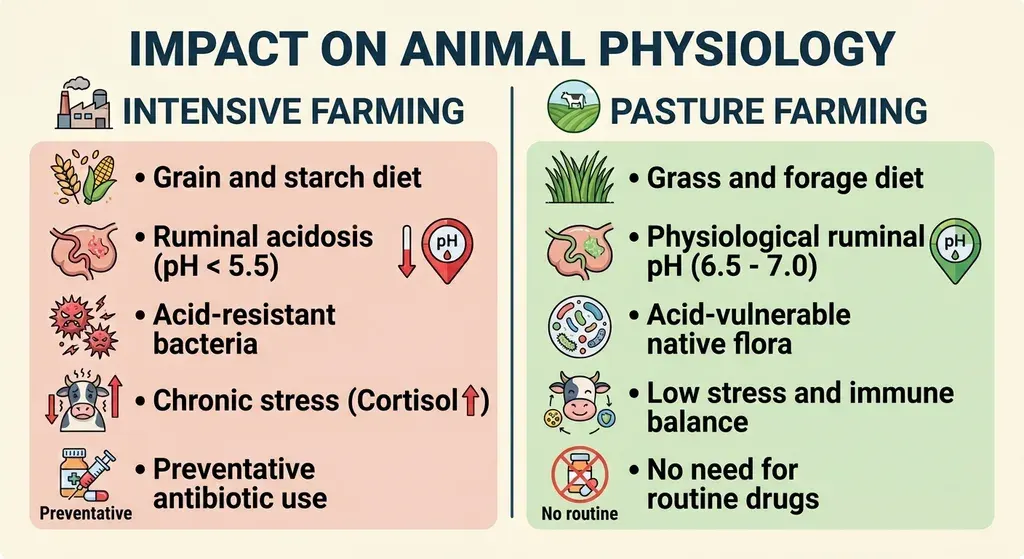
Ruminants are not designed to process large amounts of refined starch. In the wild, the animal’s plant digester operates at a neutral, healthy pH (between 6.5 and 7.0).
When fresh forage is replaced by concentrated feed, the rapid fermentation of starch generates a massive build-up of lactic acid. Ruminal pH plunges below 5.5, causing chronic ruminal acidosis. That extreme acidity destroys the animal’s digestive mucosa, producing ulcers, internal inflammation and constant discomfort.
The danger of ultra-resistant bacteria
This shift in pH acts as a natural selection filter. Such an acidic environment destroys the beneficial microbiota and lets highly aggressive bacterial strains proliferate, such as the feared enterohaemorrhagic Escherichia coli (O157:H7).
This is a direct risk to your health:
- In industrially raised cattle: living in an acidic environment inside the animal, E. coli adapts and develops a high acid resistance. If it ends up contaminating the meat during processing, it easily survives the hydrochloric acid bath of your stomach and infects your digestive tract.
- In grass-fed cattle: E. coli developed in a neutral rumen is very sensitive to acidity, so your gastric juices neutralise it naturally.
Chronic stress and immunosuppression
Overcrowding, transport and the loss of natural social structure trigger a continuous output of cortisol and adrenaline in the animal. This chronic stress causes:
- Intestinal permeability: the ruminant’s digestive barrier weakens, letting pathogenic bacteria and endotoxins pass into its bloodstream.
- Immune depression: the animal’s defence system collapses, leaving it extremely vulnerable to any infection.
The vicious circle of antibiotics
Digestive acidosis, perforated mucosa and immunosuppression are the perfect breeding ground for epidemics in feedlots. To avoid mass die-offs, intensive farming resorts to the prophylactic, systematic use of antibiotics. This practice is, today, one of the main drivers behind the global antibiotic resistance crisis in human medicine.
Health and planetary sustainability
There is a widespread narrative that eating meat inevitably destroys the planet. But lumping industrial farming together with regenerative farming is confusing the problem with the solution.
The real impact of the intensive model
Industrial livestock farming devours resources: it requires deforesting thousands of hectares to grow grain monocultures with petroleum-derived fertilisers and massive water use. On top of that, the huge accumulation of slurry in feedlots leaches away and contaminates groundwater with nitrates.
The solution: regenerative farming
At the opposite end, holistic grazing management (where animals rotate, mimicking the dynamics of wild herds) naturally stimulates plant growth. Trampling and manure activate the soil’s microbial life, turning it into a genuine carbon sink.
Living soil rich in organic matter not only captures CO₂ from the atmosphere, it also retains large volumes of rainwater, halts erosion and restores the biodiversity of insects, birds and microorganisms.
Science without bias: dismantling the narratives against meat
To judge grass-fed meat fairly, we need to put the most common myths that have demonised red meat in recent years under the scientific lens.
Myth 1: «Red meat causes cancer and heart disease»
- The evidence: media alarms usually rest on observational studies with very weak associations, biased by the «healthy user» effect: historically, people who ate more supermarket red meat also tended to smoke more, be more sedentary and overconsume ultra-processed foods.
- The reality: science clearly distinguishes between processed meat (low-quality cold cuts, industrial sausages) and fresh, unprocessed meat. There are no biological mechanisms showing that fresh meat from a healthy animal causes chronic disease within a healthy lifestyle.
Myth 2: «Saturated fats clog your arteries»
- The evidence: the simplistic hypothesis that saturated fat blocks blood vessels has been disproved. The saturated fatty acids in fresh meat (such as stearic acid) have a neutral effect on cholesterol, or increase the size of LDL particles, making them harmless.
- The reality: the real drivers of atherosclerosis are vascular inflammation and oxidative stress, factors that grass-fed meat helps mitigate thanks to its abundance of antioxidants and its low Omega-6 content.
Myth 3: «Methane from livestock destroys the ozone layer»
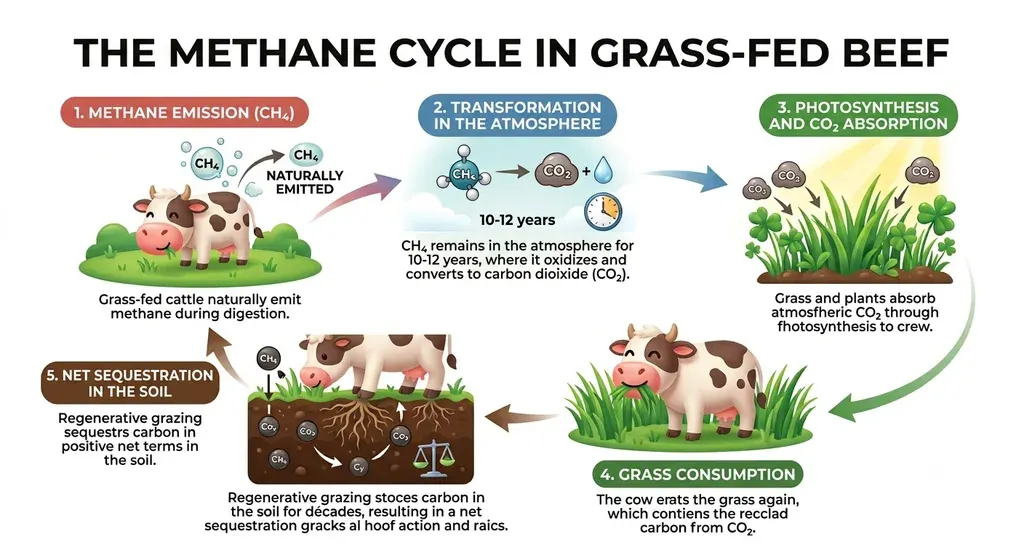
- The evidence: the methane (CH₄) emitted by ruminant digestion is part of the biogenic carbon cycle. This gas breaks down in the atmosphere in about 10-12 years into CO₂ and water, which are reabsorbed by the pastures themselves through photosynthesis.
- The reality: this has nothing to do with emissions from the fossil fuel sector, which release ancient carbon buried for millions of years. A grass-fed cow in a regenerative system sequesters more carbon in the soil than it emits over its lifetime.
Myth 4: «All meat is nutritionally the same»
- The evidence: the digestive physiology of ruminants is adapted to ferment plant fibre. Altering their diet with grain drastically transforms the pH of their digestive tract and changes the lipid structure of their tissues.
- The reality: a steak from 100 % grass-fed cattle and one from an industrial feedlot are two metabolically and nutritionally different foods.
Conclusion: reclaiming real meat
For millions of years, meat produced naturally by animals integrated into their ecosystems was a fundamental pillar of human nutritional evolution. Twentieth-century industrialisation broke that balance, turning a nutrient-dense food into a mass-produced product stripped of its original biochemical richness and deeply harmful to the environment.
Defending grass-fed meat is not defending the current livestock model: it is defending a return to biological coherence. By choosing animals raised in harmony with the land, you are not only protecting your own health, you are backing a production model capable of regenerating soils, restoring biodiversity and guaranteeing real animal welfare.
References and scientific support
- Fatty acid profile and antioxidants. Daley, C. A., Abbott, A., Doyle, P. S., Nader, G. A., & Larson, S. (2010). A review of fatty acid profiles and antioxidant content in grass-fed and grain-fed beef. Nutrition Journal, 9(10). View study (DOI)
- Phytonutrients in grass-fed meat. Van Vliet, S., Provenza, F. D., & Kronberg, S. L. (2021). Health-promoting phytonutrients are higher in grass-fed meat and milk than in grain-fed counterparts. Frontiers in Sustainable Food Systems, 4, 555426. View study (DOI)
- Grain, ruminal acidity and acid-resistant E. coli. Diez-Gonzalez, F., Callaway, T. R., Kizoulis, M. G., & Russell, J. B. (1998). Grain feeding and the dissemination of acid-resistant Escherichia coli from cattle. Science, 281(5383), 1666-1668. View study (DOI)
- The physiology of ruminal acidosis. Nagaraja, T. G., & Titgemeyer, E. C. (2007). Ruminal acidosis in beef cattle: the current microbiological and nutritional outlook. Journal of Dairy Science, 90(S1), E17-E38. View study (DOI)
- Stress and pathogen shedding in livestock. Verbrugghe, E., Boyen, F., Gaastra, W., Bekhuis, L., Leyman, B., Van Parys, A., Haesebrouck, F., & Pasmans, F. (2012). The complex interplay between stress and bacterial infections in animals. Veterinary Microbiology, 155(2-4), 115-127. View study (DOI)
- Antibiotics in livestock and public health. Landers, T. F., Cohen, B., Wittum, T. E., & Larson, E. L. (2012). A review of antibiotic use in food animals: perspective, policy, and potential. Public Health Reports, 127(1), 4-22. View study (DOI)
- Ruminants and the carbon footprint. Teague, W. R., Apfelbaum, S., Lal, R., Kreuter, U. P., Rowntree, J., Davies, C. A., Conser, R., Rasmussen, M., Hatfield, J., Wang, T., Wang, F., & Byck, P. (2016). The role of ruminants in reducing agriculture’s carbon footprint in North America. Journal of Soil and Water Conservation, 71(2), 156-164. View study (DOI)
- Regenerative vs. conventional systems. Rowntree, J. E., Stanley, P. L., Maciel, I. C. F., Thorbecke, M., Rosenzweig, S. T., Hancock, D. W., Guzman, A., & Raven, M. R. (2020). Ecosystem impacts and productive capacity of a multi-species pastured livestock system. Frontiers in Sustainable Food Systems, 4, 544984. View study (DOI)
We're building the space for you to comment on the articles.
Continue reading

Glycine: the forgotten building block of life
The key amino acid that slows cellular ageing, improves sleep and rebuilds your tissues from within

The electricity of food
The metabolic pathways of the macronutrients and how mitochondria reduce food to a source of electrons