The truth about antioxidants
The biology behind our real defence network against oxidative stress

The global supplement and superfood industry turns over billions of euros a year on the back of an unbeatable promise: to slow ageing and shield us from disease through resveratrol capsules, green smoothies and flavonoid-loaded supplements. We have been sold the idea that the more antioxidants we take in from outside, the healthier and longer-lived we will be.
Yet large-scale systematic reviews and meta-analyses are beginning to reveal a very different picture: the mass consumption of synthetic antioxidants and exogenous phytochemicals not only fails to extend life, but in many cases is associated with increased cellular stress and even higher mortality.
What if the answer lay neither in plants nor in pills? What if our own body already possessed the definitive antioxidant defence system, one we simply need to protect and strengthen?
The dance of electrons and the need for oxidation
To understand antioxidants, we first have to demystify their supposed enemies: free radicals.
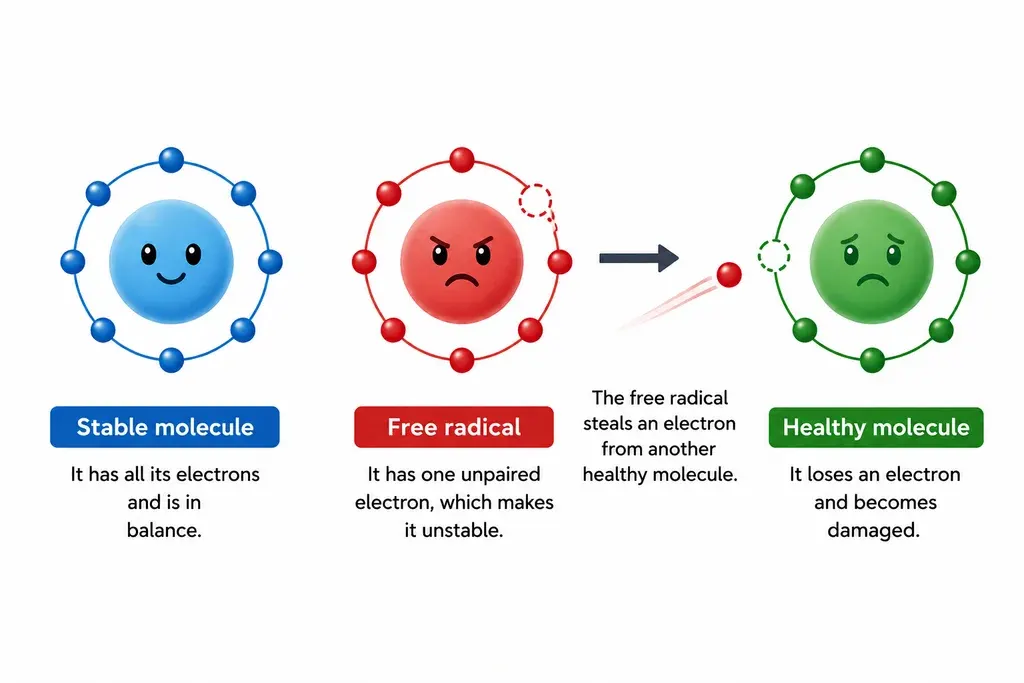
At the atomic level, molecules seek stability by keeping their electrons in pairs. A free radical is nothing more than an atom or molecule missing an electron in its outer shell. Picture a juggler who has dropped one of his balls and panics: to regain his balance, he violently snatches a ball from the nearest person. That person, now off balance, snatches one from the next, setting off a chain reaction. This is what biology calls oxidative stress.
Antioxidants step in as peaceful mediators: they donate one of their own electrons to the free radical to neutralise it, without becoming unstable in the process.
For decades it was assumed that oxidation had to be eradicated at all costs. Nothing could be further from the truth. A physiological amount of free radicals is absolutely indispensable to human life. They act as cell-signalling molecules, they trigger our immune response against pathogens, and they set off apoptosis (the programmed removal of defective or cancerous cells). Chasing “absolute zero” oxidation simply means bringing the machinery of life to a halt.
The dilemma of external antioxidants
How do we know that polyphenol smoothies and concentrated vitamin supplements do not work in the body the way they are advertised on television?
The answer lies in bioavailability and metabolic scale. Many of the claimed benefits of polyphenols and flavonoids come from in vitro studies, that is, work carried out in test tubes where the compound is poured directly onto a cell culture. But the human body is not a test tube: it is an extraordinarily complex digestive and metabolic ecosystem.
When we ingest plant-derived antioxidants, our digestive tract absorbs them in minute quantities. What is more, unlike hunger or thirst, the body has no hormonal self-regulating mechanism to limit the intake of synthetic or exogenous antioxidants. At high doses these compounds can undergo a functional reversal and act as pro-oxidants, upsetting the delicate cellular balance and causing more damage than they promised to repair.
The antinutrient trap
Unlike animals, plants cannot flee or physically defend themselves from predators. Over millions of years of evolution they have therefore developed a sophisticated chemical arsenal to deter anything that tries to eat them. Chief among these substances are antinutrients and secondary metabolites.
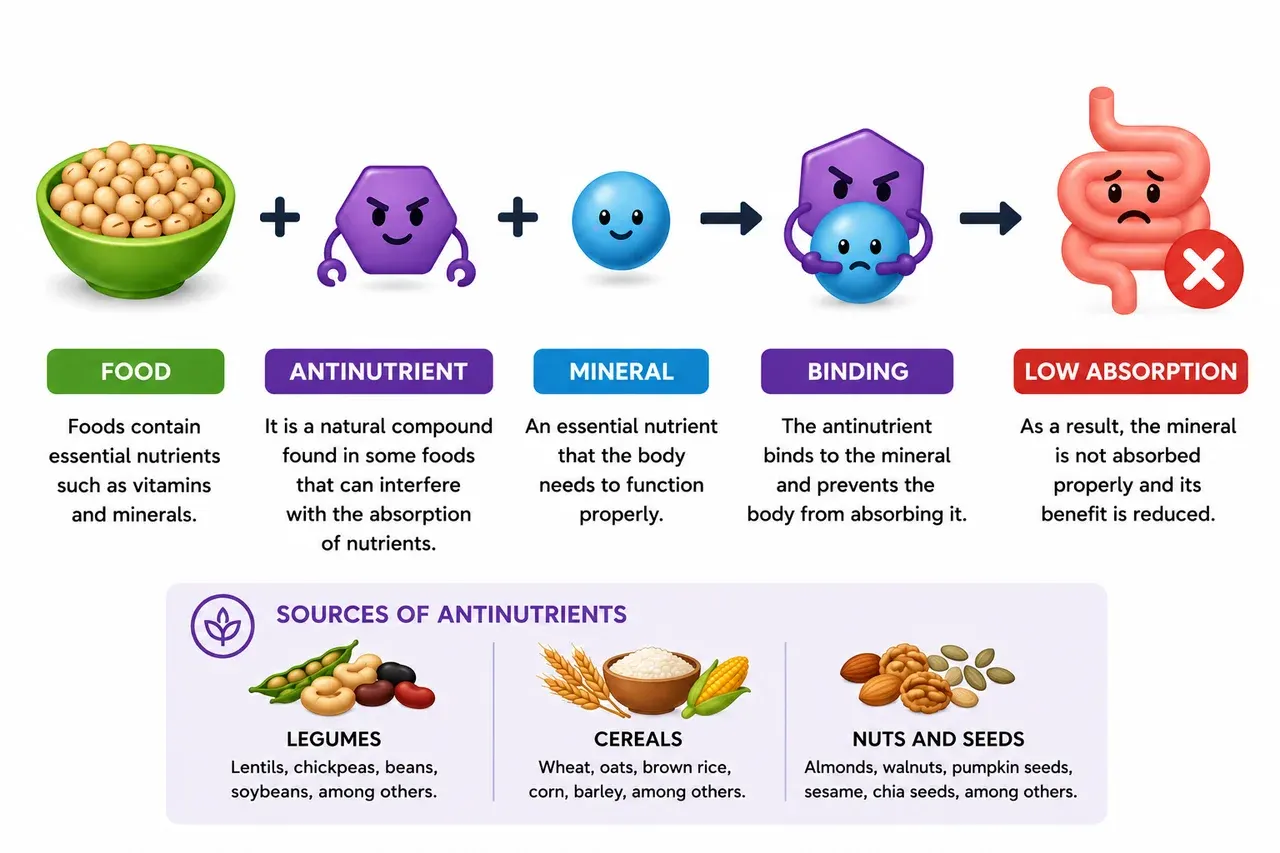
Compounds such as oxalates, phytates and lectins interfere directly with the absorption of essential minerals — calcium, iron, zinc and magnesium — by forming insoluble complexes in the digestive tract. On top of that, many of the so-called “antioxidant phytonutrients” (polyphenols and flavonoids) actually behave as mild toxins the plant produces for its own protection, not for human health.
Claiming that these substances benefit us through a supposed hormetic effect (where “what doesn’t kill you makes you stronger”) is a hypothesis that long-term clinical trials have not demonstrated. Subjecting the body to mild, recurrent poisoning through the diet can overload the liver’s detoxification pathways and weaken the intestinal barrier, outweighing the theoretical benefit attributed to it.
The golden triad of endogenous defence
You don’t need to buy antioxidants: you need to give your body the raw material and the environment to make its own.
Fortunately, evolution equipped us with an antioxidant system of our own, self-regulating and significantly more effective than any exogenous supplement. These three endogenous pillars work without pause to protect our cells:
1. Glutathione
Glutathione is not efficiently absorbed through direct oral supplements; it is synthesised inside almost every cell in the body from three key amino acids: glutamate, cysteine and glycine. It is responsible for directly neutralising reactive oxygen species and for recycling other antioxidants. To maintain optimal glutathione levels, the key is not to take it directly (it is almost entirely broken down during digestion) but to supply your body with the right raw material: high-biological-value proteins and nutrient-dense foods.
2. Melatonin
Beyond regulating the sleep cycle, science has discovered that melatonin is one of the most powerful mitochondrial protectors and neuroprotectors there is. Most melatonin does not come from the pineal gland: it is synthesised inside the mitochondria themselves in response to daytime sunlight exposure, shielding the cells’ “power plants” from oxidative damage.
3. Uric acid
Often vilified for its association with gout in cases of metabolic dysfunction, uric acid at normal physiological concentrations accounts for more than 50% of the total antioxidant capacity of blood plasma. It neutralises nitrogen and oxygen free radicals on a massive scale throughout the circulation.
Practical strategies to optimise your biology
If the goal is not to consume more antioxidants from outside but to boost the ones your own body manufactures, the strategy has to be built on lifestyle and evolutionary biology:
- Supply the right substrate: prioritise nutrient-dense foods with a complete profile of essential amino acids (such as meat, fish, eggs and shellfish) to fuel the continuous synthesis of glutathione and antioxidant enzymes.
- Synchronise your circadian rhythms: expose your eyes and skin to sunlight during the first hours of the day to stimulate mitochondrial melatonin production. As night falls, drastically reduce your exposure to artificial blue light so the cellular repair cycle can run its course.
- Reconnect with your surroundings (grounding): direct physical contact with the earth’s surface — walking barefoot on grass, soil or sand — allows free electrons from the environment to be absorbed, helping to neutralise the oxidative load naturally and physiologically.
Conclusion
Nature does not make blunders as crude as leaving our survival to depend on finding an exotic berry or taking a daily pill. Your body is a biochemical machine refined over millions of years.
When you stop overloading it with synthetic compounds and give it the right biological materials, along with the right environment of light, rest and nature, its ability to manage oxidative stress outstrips any commercial alternative. Cellular health is cultivated from within.
References and scientific support
- Mortality in trials of antioxidant supplements. Bjelakovic, G., Nikolova, D., Gluud, L. L., Simonetti, R. G., & Gluud, C. (2007). Mortality in randomized trials of antioxidant supplements for primary and secondary prevention: systematic review and meta-analysis. JAMA, 297(8), 842-857. View study on PubMed
- Efficacy of supplements in cardiovascular prevention. Myung, S. K., Ju, W., Cho, B., Oh, S. W., Park, S. M., Koo, B. K., & Park, B. J. (2013). Efficacy of vitamin and antioxidant supplements in prevention of cardiovascular disease: systematic review and meta-analysis of randomised controlled trials. BMJ, 346, f10. View study on PubMed
- The concept of mitohormesis. Ristow, M., & Zarse, K. (2010). How increased oxidative stress promotes longevity and metabolic health: The concept of mitochondrial hormesis (mitohormesis). Experimental Gerontology, 45(6), 410-418. View study on PubMed
- The reference work on free radicals. Halliwell, B., & Gutteridge, J. M. C. (2015). Free Radicals in Biology and Medicine (5th ed.). Oxford University Press. View on Oxford Academic
- Physiological roles of reactive oxygen species. Sena, L. A., & Chandel, N. S. (2012). Physiological roles of mitochondrial reactive oxygen species. Molecular Cell, 48(2), 158-167. View study on PubMed
- Reactive species and the immune system. Nathan, C., & Cunningham-Bussel, A. (2013). Beyond oxidative stress: an immunologist’s guide to reactive oxygen species. Nature Reviews Immunology, 13(5), 349-361. View study on PubMed
We're building the space for you to comment on the articles.
Continue reading

Glycine: the forgotten building block of life
The key amino acid that slows cellular ageing, improves sleep and rebuilds your tissues from within

Vitamin B3
The currency the cell spends on its energy and on repairing its DNA