Vitamin B3
The currency the cell spends on its energy and on repairing its DNA

In the summer of 1914, the asylums and orphanages of the American South became the stage for an epidemic nightmare as devastating as it was baffling. Thousands of people were admitted with an identical, terrifying pattern: skin exposed to the sun turned thick, dark and scaly, as though it had been baked in an oven; the mind sank into a delirious psychosis; the digestive tract collapsed into uncontrollable diarrhoea and, finally, death brought down the curtain. For decades the health authorities were convinced they were facing a killer germ, a highly contagious microorganism preying on the most disadvantaged layers of society.
The epidemiologist Joseph Goldberger, however, noticed an anomaly that demolished the infectious theory: while patients were dying by the dozen inside the asylums, the doctors and nurses who tended them every day —breathing the same air and touching the same sores— showed not the slightest symptom. The difference between life and death was not an invisible pathogen but the canteen menu. While the inmates lived on maize flour, fatty bacon and molasses, the medical staff enjoyed a varied diet rich in meat, milk and eggs.
Goldberger proved it with experiments that would make any ethics committee shudder today —he injected himself, his wife and other volunteers with fluids from the sick to show there was no contagion—: the devastating pellagra was not an infection but a cry for help from a body deprived of one tiny, indestructible molecule. That molecule was niacin, vitamin B3: the cornerstone of energy metabolism, without which every one of your cells simply switches off.
Technical profile
| Parameter | Detail |
|---|---|
| Chemical names | Nicotinic acid, nicotinamide and nicotinamide riboside, gathered under the common name niacin. |
| Type | Water-soluble, from the B complex: it is barely stored and has to be topped up daily. |
| Main superpower | Building NAD⁺, the currency the cell spends on both energy production and the repair of its own DNA. |
| Quick fun fact | Maize is loaded with vitamin B3, but keeps it under a chemical lock our gut cannot pick — unless the grain is cooked with lime, an ancient Mesoamerican trick. |
A little history…
To understand the story of vitamin B3 we have to travel back to the sixteenth century, when the Spanish conquistadors returned from the Americas fascinated by a golden grain that fed the Aztec and Maya empires: maize. The crop spread like wildfire across Europe and, later, across the American South, until it became the staple food of the peasant classes thanks to its enormous agricultural yield and low cost.
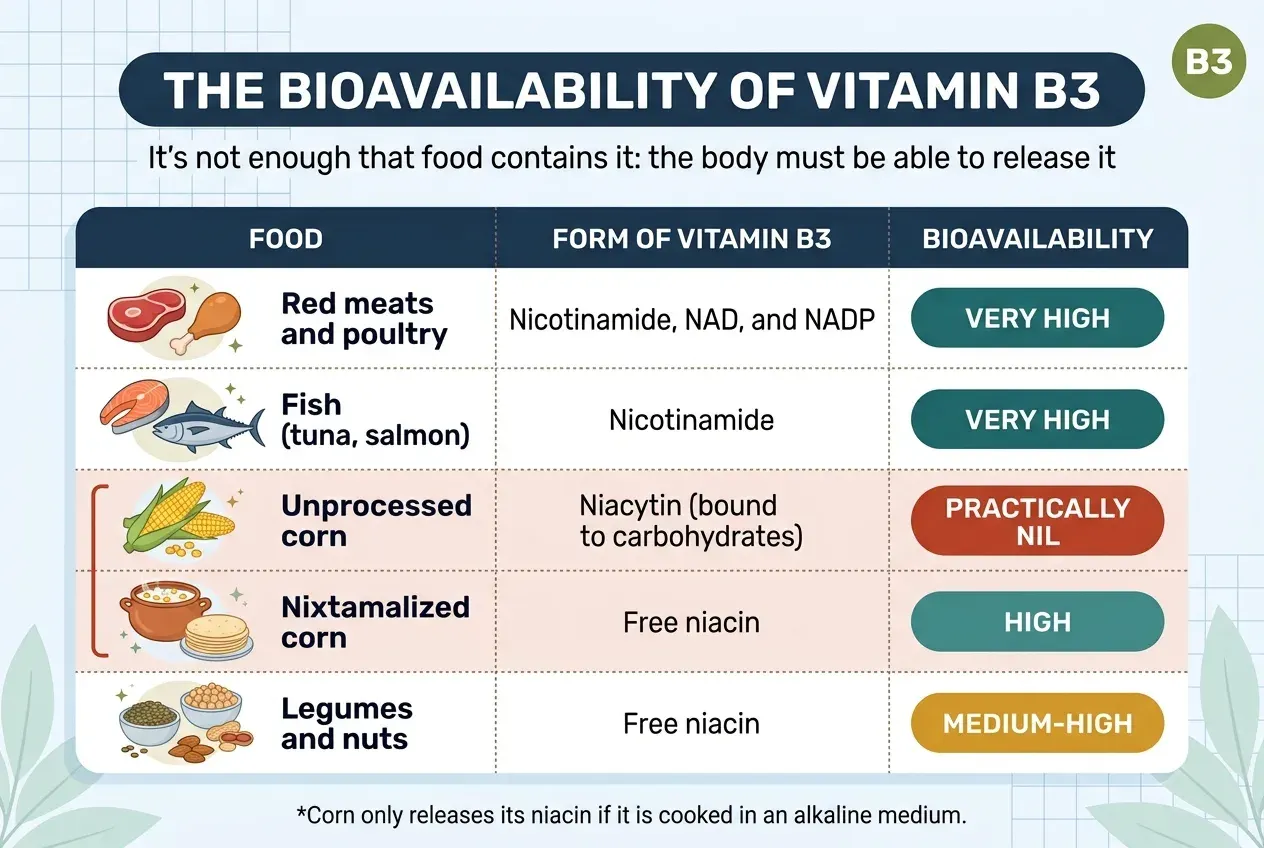
What Europe did not import was the ancestral knowledge that came with it. Mesoamerican peoples never ate maize simply ground: they first boiled it in an alkaline solution of water with slaked lime or wood ash. That process, nixtamalisation, was not merely a culinary tradition but an indispensable piece of nutritional alchemy. The vitamin B3 in maize is chemically bound to complexes of carbohydrates and peptides —the compounds known as niacytin and niacinogen— and in that form the human digestive system cannot break the bonds: the vitamin goes in and comes out intact, without delivering a single microgram of nutrition. The alkaline environment of the lime shatters that chemical prison and frees the niacin so it can be absorbed.
By skipping that step, Europe and North America suffered a silent plague for more than two centuries. In Italy it was christened pelle agra, «sour skin», which is where our pellagra comes from: a disease that deformed bodies and unhinged minds. The blame was laid on the climate, on genetics, on fungi in rotten grain and even on the «moral degradation» of those who suffered it.
It was not until 1937 that the American biochemist Conrad Elvehjem, working with liver extracts that cured «black tongue» in dogs —the canine equivalent of pellagra—, finally managed to isolate nicotinic acid. The curious part is that the substance had been described decades earlier: the Austrian chemist Hugo Weidel had obtained it in 1873 by oxidising the nicotine in tobacco, but it lay forgotten on the shelves of organic chemistry as a compound with no known biological function. To keep the public from associating the vital nutrient with the dangers of cigarettes, it was renamed with a commercial acronym: nicotinic acid + vitamin = niacin.
A manual of cellular mechanics: what does vitamin B3 do in your body?
Down in the cellular microcosm, vitamin B3 reveals itself not as a passive structure but as the key part of the two most important molecular battery chargers in the body: NAD⁺ (nicotinamide adenine dinucleotide) and NADP⁺ (nicotinamide adenine dinucleotide phosphate).
Imagine your cells as a vast industrial metropolis. You have eaten a plate of rice —raw fuel— but the machines in your cells do not run on rice: they run on ATP, refined energy. This is where vitamin B3 comes in.
Converted into NAD⁺ and NADP⁺, B3 behaves like an infinite fleet of lorries on an assembly line. Its only job is to collect electrons —pure energy— from the nutrients you are breaking down and carry them at full speed to the mitochondria, the cell’s power stations. Without those lorries the assembly line stops, metabolism collapses and cells starve no matter how much you have eaten.
But NAD⁺ has a second trade, and it is the one that has placed niacin at the centre of the biology of ageing. Besides lending electrons and getting them back intact, there are enzymes that consume it: they split it and keep a piece. Every time that happens, the cell spends a molecule it will have to replace.
Rescuing the genome: the PARP enzymes
Every day your DNA suffers thousands of breaks from radiation, free radicals and toxins. Enzymes called PARPs (poly-ADP-ribose polymerases) patrol the cell nucleus; when they spot a fault they consume enormous amounts of NAD⁺ to flag the damage and recruit the repair machinery. If B3 levels fall, the PARPs run out of ammunition and mutations pile up.
Sirtuins: the misnamed «longevity genes»
Sirtuins (SIRT1 to SIRT7) are enzymes that switch off inflammatory genes, optimise fat burning and promote mitochondrial biogenesis. The media label they carry is imprecise: they are not genes but the proteins certain genes build. What is firmly established is their dependency. Sirtuins are strictly NAD⁺-dependent: if there is not enough B3 to hold up the levels of this coenzyme, they doze off and physiological decline accelerates.
The art of bioavailability
Unlike other B-complex vitamins, extremely fragile in the face of heat or air, vitamin B3 is a genuine survivor. Its pyridine ring structure makes it extraordinarily stable: it withstands cooking, exposure to light and both acidic and alkaline environments. Its water-soluble nature, on the other hand, does pose a few challenges in the kitchen.
The secret of nixtamalisation
Maize is one of the most fascinating lessons in culinary biochemistry in history. The grain contains large amounts of niacin, but bound to hemicelluloses and peptides in a complex called niacytin. The human digestive system lacks the enzymes needed to break that bond, so the niacin passes through the gut without being absorbed.
The native peoples of Mesoamerica solved the problem intuitively with nixtamalisation: cooking the maize in water mixed with wood ash or slaked lime (calcium hydroxide). The strongly alkaline medium breaks the ester bonds of niacytin and releases the niacin in its free, fully bioavailable form. When Europeans exported maize to the rest of the world, they left that ritual cooking step behind — and with it unleashed the historic epidemics of pellagra.
The secret route: tryptophan
Your body keeps an ace up its sleeve: it can build its own vitamin B3 from an essential amino acid present in proteins, tryptophan. The route runs through the liver, but it is remarkably inefficient: you need around 60 mg of dietary tryptophan to synthesise barely 1 mg of niacin. That is why nutritional requirements are not measured in milligrams of the vitamin but in niacin equivalents (NE): the niacin you eat plus whatever your liver manages to build from the protein reaching it.
Synergies and saboteurs in the kitchen
- The leaching hazard. Although heat does not destroy B3, prolonged boiling drags the vitamin into the cooking water. If you boil chicken breast or pulses and pour the broth away, you will be tipping up to 30 % of their vitamin content down the sink. Always make use of the juices and stocks in soups or stews.
- The synergy with B6, B2 and iron. Converting tryptophan into niacin does not happen by magic: it requires the indispensable help of vitamin B6, iron and riboflavin (B2) as cofactors. If you are anaemic or short of B6, the internal B3 production route is completely blocked.
- The alcohol brake. Chronic alcohol consumption destroys the enterocytes —the intestinal cells in charge of absorbing the vitamin— and drastically alters the liver’s ability to process tryptophan. It is the number one cause of relative deficiency in the developed world.
Light and shadow: deficiency versus toxicity
Vitamin B3 is a perfect illustration of the biological principle of hormesis: the dose decides whether we are dealing with a life-saving nutrient, a therapeutic drug or a substance with uncomfortable side effects.
The deficit: the four «D» rule
Severe vitamin B3 deficiency leads to classic pellagra, whose clinical progression is universally known in medicine as the four «D» rule:
- Dermatitis. Symmetrical, hyperpigmented, rough and flaking lesions that appear strictly on the areas of skin exposed to sunlight, forming the classic «Casal necklace» around the neck.
- Diarrhoea. Generalised inflammation of the lining of the digestive tract, from a painful glossitis that turns the tongue scarlet to nausea, vomiting and recurrent watery stools, because the intestinal epithelium can no longer regenerate.
- Dementia. Progressive cognitive decline that begins with insomnia, fatigue and irritability, advances into depression and mental confusion, and culminates in hallucinations, paranoia and psychosis.
- Death. If the deficiency is not reversed by giving niacin, multi-organ failure and metabolic collapse lead inevitably to death within one to three years.
In its mild or subclinical stages the deficiency does not show that destructive face, but it does appear as persistent brain fog, slow digestion, recurrent mouth ulcers and an insidious chronic fatigue at the slightest physical effort.
Toxicity: the niacin flush
Being water-soluble, the excess that arrives through the diet is excreted without difficulty in the urine. With the megadoses of high-strength supplements —especially in the form of nicotinic acid— a striking physiological phenomenon appears instead: the niacin flush.
A few minutes after taking a high dose of nicotinic acid, above 50 mg, the face, neck and chest redden intensely, with a sensation of burning, suffocating heat and tingling.
The cellular mechanism of the flush: nicotinic acid binds to the HM74A receptor present in skin cells, which triggers a massive release of prostaglandins D2 and E2, rapidly dilating the superficial blood capillaries. It is usually harmless and fades after 30-60 minutes, but it is alarming for anyone experiencing it for the first time.
At even higher therapeutic doses —above 1,000-3,000 mg a day, the ones historically used to treat dyslipidaemia— supplementation demands strict medical supervision: it can induce hepatotoxicity, raise blood glucose (insulin resistance) and cause hyperuricaemia, with the gout attacks that follow.
The myth corner
«Taking niacin is the definitive way to prevent cardiovascular events»
In the late twentieth century, niacin was cardiology’s great star. High doses of nicotinic acid were known to cut LDL cholesterol by up to 15 % and raise HDL cholesterol by a dazzling 30 %, and for years it was prescribed on a massive scale.
Evidence-based medicine took a sharp turn after two large-scale clinical trials were published: AIM-HIGH and HPS2-THRIVE. Researchers ran into an uncomfortable paradox: although pharmacological niacin moved the numbers on the blood tests, it did not significantly reduce major cardiovascular events, heart attacks or overall mortality. On top of that, it increased the risk of serious side effects such as bleeding, infections and new-onset diabetes.
The scientific literature now widely records that artificially altering cholesterol values is no guarantee of avoiding a cardiovascular event and that it can, moreover, have dangerous consequences for the body. Cholesterol is a substance the body produces endogenously and needs in order to work properly, because it performs vital functions.
The scientific frontier
If traditional niacin no longer dazzles in cardiology, it has found an infinitely more fascinating throne in the biology of ageing. As we get older, NAD⁺ levels in our tissues plummet: by 50 we have roughly half of what we had at 20. That fall undermines the cell’s ability to repair DNA and maintain mitochondrial function.
Laboratories around the world are now investigating two advanced forms of the B3 family: nicotinamide riboside (NR) and nicotinamide mononucleotide (NMN). Unlike ordinary niacin, these precursors enter the NAD⁺ salvage biosynthetic pathway at a lower cellular energy cost and without triggering the irritating skin flush.
Recent studies suggest that restoring NAD⁺ levels with these B3 derivatives could:
- Rejuvenate mitochondrial function in skeletal muscle.
- Improve insulin sensitivity in metabolic tissues.
- Protect against neurodegeneration in models of Alzheimer’s and Parkinson’s by reducing glial inflammation.
- Boost the regenerative capacity of the vascular epithelium.
Science remains cautious and is still assessing long-term safety and efficacy in humans, but vitamin B3 has settled at the absolute epicentre of twenty-first-century regenerative medicine.
Next stop…
On our tour of the nutritional map of life we have worked out how a humble molecule was able to subdue historic epidemics and become the secret key to our molecular engines. But the metabolic chain does not stop here.
Next article: vitamin B5 (pantothenic acid), the omnipresent ingredient without which the chemistry of life would simply not know where to start building.
References and scientific support
- The observation that dismantled the contagion theory. Goldberger, J. (1914). The etiology of pellagra: the significance of certain epidemiological observations with respect thereto. Public Health Reports, 29(26), 1683-1686. View on PubMed
- The study that isolated nicotinic acid as the factor curing pellagra. Elvehjem, C. A., Madden, R. J., Strong, F. M., & Woolley, D. W. (1937). Relation of nicotinic acid and nicotinic acid amide to canine black tongue. Journal of the American Chemical Society, 59(9), 1767-1768. View study (DOI)
- How nixtamalisation frees the niacin maize keeps under lock and key. Katz, S. H., Hediger, M. L., & Valleroy, L. A. (1974). Traditional maize processing techniques in the New World. Science, 184(4138), 765-773. View study (DOI)
- NAD⁺ as the critical substrate for sirtuins in ageing and disease. Imai, S., & Guarente, L. (2014). NAD+ and sirtuins in aging and disease. Trends in Cell Biology, 24(8), 464-471. View study (DOI)
- The PARP enzyme family and the NAD⁺ they spend on repairing DNA. Amé, J.-C., Spenlehauer, C., & de Murcia, G. (2004). The PARP superfamily. BioEssays, 26(8), 882-893. View study (DOI)
- The trial that fixed the equivalence at 60 mg of tryptophan per milligram of niacin. Horwitt, M. K., Harvey, C. C., Rothwell, W. S., Cutler, J. L., & Haffron, D. (1956). Tryptophan-niacin relationships in man. The Journal of Nutrition, 60(suppl. 1), 1-43. View study (DOI)
- Adding niacin to statin therapy did not reduce cardiovascular events. The AIM-HIGH Investigators (2011). Niacin in patients with low HDL cholesterol levels receiving intensive statin therapy. The New England Journal of Medicine, 365(24), 2255-2267. View study (DOI)
- The 25,673 patients who confirmed the absent benefit and the excess of adverse effects. The HPS2-THRIVE Collaborative Group (2014). Effects of extended-release niacin with laropiprant in high-risk patients. The New England Journal of Medicine, 371(3), 203-212. View study (DOI)
- The first pharmacokinetic trial of nicotinamide riboside in humans. Trammell, S. A. J., Schmidt, M. S., Weidemann, B. J., Redpath, P., Jaksch, F., Dellinger, R. W., Li, Z., Abel, E. D., Migaud, M. E., & Brenner, C. (2016). Nicotinamide riboside is uniquely and orally bioavailable in mice and humans. Nature Communications, 7, 12948. View study (DOI)
- The review that sorts out what is known about NMN and NR against age-related metabolic decline. Yoshino, J., Baur, J. A., & Imai, S. (2018). NAD+ intermediates: the biology and therapeutic potential of NMN and NR. Cell Metabolism, 27(3), 513-528. View study (DOI)
We're building the space for you to comment on the articles.
Continue reading

Glycine: the forgotten building block of life
The key amino acid that slows cellular ageing, improves sleep and rebuilds your tissues from within
The electricity of food
The metabolic pathways of the macronutrients and how mitochondria reduce food to a source of electrons

The molecular architecture
Chain length, degree of saturation and the metabolic fate of fatty acids