Vitamin B2
The fluorescent pigment that turns food into energy
If you have ever taken a multivitamin or an energy drink and, a couple of hours later, had a fright in the bathroom at the sight of urine dyed a neon yellow that looks almost radioactive, congratulations: you have just witnessed the luminescent spectacle of vitamin B2. Far from being cause for medical alarm, that urinary phosphorescence is the unmistakable sign that your body is filtering out the excess of one of the most curious metabolic engines in human biochemistry.
If you turned off the lights and switched on an ultraviolet lamp in that same bathroom, the liquid would glow with an intense yellow-green fluorescence. Vitamin B2, known chemically as riboflavin, is not merely an essential nutrient: it is a vibrant pigment. Its name comes from joining ribose —the sugar that forms part of its structure— to flavus, the Latin word for «yellow».
But this molecule is not in your body to put on a light show. Riboflavin holds in its chemical structure the best-kept secret of your mitochondria: the ability to snatch electrons from the food you eat and turn them into the pure energy that keeps your heart beating and your neurons firing.
Without that golden spark, the cellular machinery simply seizes up. Glucose, fats and proteins would pile up in your cells with nothing and no one able to extract their true energetic potential.
Technical profile
| Parameter | Detail |
|---|---|
| Chemical names | Riboflavin, formerly called vitamin G or lactoflavin. Its active coenzyme forms are flavin mononucleotide (FMN) and flavin adenine dinucleotide (FAD). |
| Type | Water-soluble, from the B complex: barely stored at all and has to be replaced daily. |
| Main superpower | Playing the «electron chameleon» and turning food into cellular fuel (ATP) through mitochondrial respiration. |
| Quick fun fact | Dissolved in water and held under a black light, pure riboflavin gives off a yellow-green glow worthy of a science-fiction film. |
A little history…
The story of how vitamin B2 was isolated did not begin in a nutrition laboratory hunting for a cure to a deadly scourge like scurvy or beriberi, but at the counter of a Victorian dairy.
In 1879, the British chemist Alexander Wynter Blyth set out to analyse the exact composition of milk whey. On separating out the milk solids he found a pigment of a dazzling yellow-green colour that showed a curious fluorescence when light fell on it. Blyth named the substance lactochrome. The science of the day, however, had neither the conceptual nor the technological tools to work out what that fluorescent molecule was doing there, and the finding was filed away as a simple curiosity for more than half a century.
By the 1920s, biochemistry was in the middle of a gold rush around the «B factor». Scientists knew that vitamin B prevented beriberi, but the numbers did not add up: when they subjected yeast extracts to extremely high temperatures, the ability to prevent beriberi vanished, yet the extract kept its power to heal certain skin lesions and to promote growth in laboratory animals. There was more than one passenger aboard the vitamin B ship.
The puzzle was solved in 1933 by a team led by the Austrian-German chemist Richard Kuhn. After processing tens of thousands of litres of egg white and milk whey, Kuhn and his collaborators managed to isolate barely a few milligrams of tiny yellow crystals. They confirmed that the pigment was exactly Blyth’s lactochrome and demonstrated its biological role. Kuhn named the molecule riboflavin, combining the ribose in its structure with the Latin flavus. The discovery earned him the Nobel Prize in Chemistry in 1938.
A manual of cellular mechanics: what does vitamin B2 do in your body?
To understand riboflavin’s magic you have to go down to the body’s boiler room: the mitochondria.
Picture your cell as a vast modern city. For everything to work —for the heart to beat, the neurons to fire and the muscles to contract— you need electricity. That biological electricity is called ATP (adenosine triphosphate). The catch is that the body cannot use food —a slice of bread, a steak— directly to make ATP: it has to extract the energy from that food in the form of electrons.
This is where our protagonist comes in. The riboflavin you eat is transformed by your cells into two vital coenzymes: FMN (flavin mononucleotide) and FAD (flavin adenine dinucleotide). Think of them as a fleet of high-security armoured trucks designed specifically to carry explosive cargo: high-energy electrons.
With those two tools in hand, riboflavin takes on three major jobs.
The electron transport chain
Inside the mitochondria, FAD and FMN collect the electrons released during cellular digestion and deliver them to the respiratory chain. That flow is what recharges the cell’s batteries: the ATP molecules. With no drivers, the cargo never arrives and the power station grinds to a halt.
Recycling glutathione
Glutathione is the body’s master antioxidant, tasked with neutralising the free radicals that damage your arteries and your DNA. Once it has neutralised a free radical, it is left «spent». To recharge and return to the fight it needs an enzyme called glutathione reductase, which cannot work without FAD. Without vitamin B2, your internal antioxidant system collapses.
The key to vitamin B6 and folate
Riboflavin also acts as a spanner for other vitamins. Converting vitamin B6 into its active form —pyridoxal 5-phosphate— and synthesising the active form of folate, 5-MTHF, depend directly on riboflavin-driven enzymes. A B2 deficit therefore ends up disguised as a deficit of other things.
The art of bioavailability
Sources of riboflavin
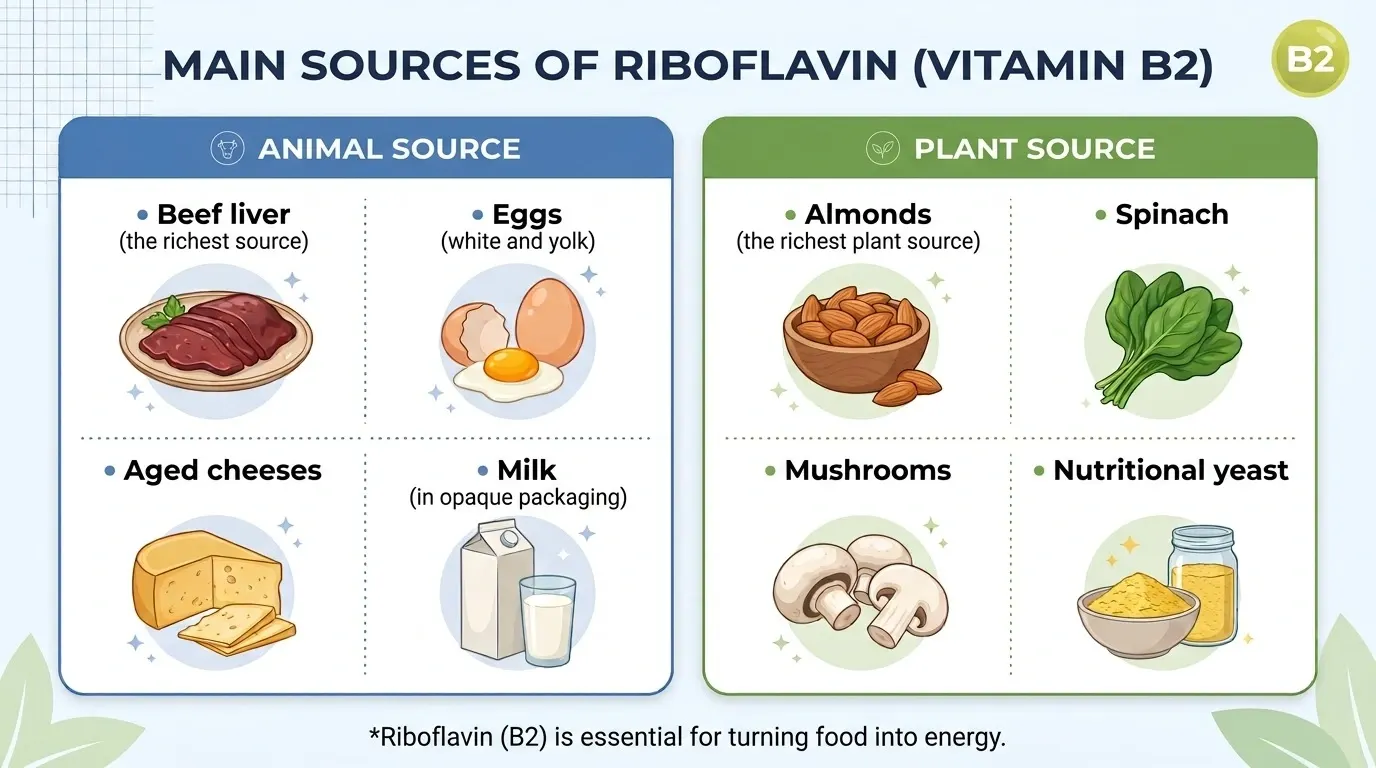
Nature has spread riboflavin across a great variety of places, though not in equal measure. Animal sources are the undisputed champions: beef liver is a B2 bomb, followed closely by eggs, aged cheeses and milk. In the plant world, your best allies are almonds —one of the richest plant sources— along with spinach, mushrooms and nutritional yeast.
The rules of absorption
Vitamin B2 absorption is a masterpiece of efficiency, but it comes with strict rules.
- Animal versus plant sources. In meat and dairy, B2 arrives in free forms or only weakly bound to proteins, so the gut absorbs nearly 100 % of it effortlessly. In plants it is more trapped in fibrous matrices, and absorption is lower.
- The kitchen. Being water-soluble, if you boil spinach in plenty of water and then pour that water down the sink, you are pouring a good share of your armoured trucks down the drain; the water will turn faintly yellow. Steaming or a quick sauté is the better option. That said, B2 is extremely heat-resistant and is not destroyed by roasting, baking or frying.
- The blockers. Chronic alcoholism destroys the intestinal transporters that absorb B2. If you drink too much, it does not matter how much riboflavin you eat: your body will close the border and refuse to let it in.
Its absolute nemesis: light
Riboflavin suffers severe photodegradation. Ultraviolet rays —and strong visible light too— break the molecule into useless pieces within hours. That is the historical reason milkmen stopped delivering milk in clear glass bottles and why the modern dairy industry uses opaque cartons or dense plastics. A glass of milk left in the sun can lose up to half its vitamin B2 in barely two hours.
Light and shadow: deficiency versus toxicity
The deficit: ariboflavinosis
Since the body can barely store riboflavin —the little it keeps sits in the liver and lasts a few weeks— the batteries start failing fast once you stop taking it in.
The cellular blackout shows up first in the fastest-regenerating tissues: the skin and the mucous membranes. The syndrome is called ariboflavinosis, and its early symptoms are deceptively ordinary:
- Angular cheilitis: painful, inflamed cracks at the corners of the lips that no lip balm will heal.
- Magenta glossitis: the tongue swells, hurts and takes on a strange, dramatic purple or magenta colour.
- Vampire eyes: the eyes become light-sensitive (photophobia), itch constantly and fill with tiny blood vessels, giving them a bloodshot look.
If the shortfall drags on, the nervous system begins to fail —neuropathy appears— and the bone marrow stops producing red blood cells, causing anaemia. With no cellular energy, the whole building collapses.
Toxicity
Is there such a thing as a B2 overdose? What happens if you swallow a whole tub of supplements? Practically nothing, except that you will stage a light show in the toilet bowl.
Vitamin B2 has a natural absorption ceiling: the adult human gut can only absorb around 27 milligrams in a single meal. Anything beyond that stays in the intestine or, if it reaches the bloodstream, is filtered out immediately by the kidneys. There is no known oral lethal dose in humans, and no documented toxicity. Your body, in its infinite elegance, takes what it needs for its transport trucks and politely expels the rest, painting your urine neon yellow to let you know the surplus has been evacuated.
The myth corner
«The supplement isn’t working because I excrete it all in my urine»
There is a widespread belief among multivitamin users: if the urine comes out neon yellow, the body is not absorbing the vitamins and the money is being thrown away. It is completely false. That fluorescent colour does not mean you failed to absorb it; it means exactly the opposite. It proves the pill dissolved, that the gut absorbed vitamin B2 into the bloodstream, and that the kidneys —doing their job to perfection— cleared out the fraction the mitochondria no longer needed. It is the sign of a waste system running like a Swiss watch.
The scientific frontier
One of the most interesting research lines of the past decade lies not in malnutrition but in neurobiology. Neurologists have found that many people with chronic migraine have, in essence, an energy problem: their brain mitochondria are less efficient and run out of steam, triggering the cascade of pain. High doses of riboflavin —around 400 mg a day— are now used with clinical success to flood the brain with FAD, improve the output of the mitochondrial turbines and significantly reduce attack frequency.
Molecular biologists are also studying how B2 is the hidden key to epigenetics: how our genes are switched on and off. There is a very common genetic variant, in the MTHFR gene, that affects how we process folic acid. It has been found that the faulty enzyme this variant produces works almost normally if the patient maintains optimal riboflavin levels, because FAD stabilises the enzyme’s shape. B2, quite literally, helps correct a genetic fault by «hugging» the mutated protein.
Next stop…
Riboflavin shows us that biology’s most decisive cogs need not be complex or enormous structures: sometimes a modest chemical ring is enough, so long as it can move electrons with the precision of a Swiss watchmaker.
In the next article: vitamin B3 (niacin), the molecule that freed entire populations from the scourge of pellagra and whose discovery redefined the course of modern medicine.
References and scientific support
- The trail from Blyth’s «lactochrome» to Kuhn’s yellow crystals. Northrop-Clewes, C. A., & Thurnham, D. I. (2012). The discovery and characterization of riboflavin. Annals of Nutrition and Metabolism, 61(3), 224-230. View study (DOI)
- The conversion of B2 into FAD and FMN and its role in oxidative phosphorylation. Nelson, D. L., & Cox, M. M. (2017). Lehninger Principles of Biochemistry (7th ed.). W. H. Freeman. View on WorldCat
- Why glutathione reductase cannot work without FAD. Ashoori, M., & Saedisomeolia, A. (2014). Riboflavin (vitamin B2) and oxidative stress: a review. British Journal of Nutrition, 111(11), 1985-1991. View study on PubMed
- How much riboflavin milk loses depending on the packaging that shields it from light. Johnson, D. S., Duncan, S. E., Bianchi, L. M., Chang, H. H., Eigel, W. N., & O’Keefe, S. F. (2015). Packaging modifications for protecting flavor of extended-shelf-life milk from light. Journal of Dairy Science, 98(4), 2205-2214. View study on PubMed
- The pioneering trial of 400 mg a day against migraine. Schoenen, J., Jacquy, J., & Lenaerts, M. (1998). Effectiveness of high-dose riboflavin in migraine prophylaxis. A randomized controlled trial. Neurology, 50(2), 466-470. View study on PubMed
- The systematic review that sorts through twenty years of riboflavin trials. Thompson, D. F., & Saluja, H. S. (2017). Prophylaxis of migraine headaches with riboflavin: a systematic review. Journal of Clinical Pharmacy and Therapeutics, 42(4), 394-403. View study on Wiley
- The riboflavin that stabilises the faulty MTHFR enzyme and lowers blood pressure. Horigan, G., McNulty, H., Ward, M., Strain, J. J., Purvis, J., & Scott, J. M. (2010). Riboflavin lowers blood pressure in cardiovascular disease patients homozygous for the 677C→T polymorphism in MTHFR. Journal of Hypertension, 28(3), 478-486. View study on PubMed
We're building the space for you to comment on the articles.
Continue reading

Glycine: the forgotten building block of life
The key amino acid that slows cellular ageing, improves sleep and rebuilds your tissues from within
The electricity of food
The metabolic pathways of the macronutrients and how mitochondria reduce food to a source of electrons

The truth about antioxidants
The biology behind our real defence network against oxidative stress